10 Post Frame Building Companies to Compare
Compare 10 post frame building companies by service area, shell or turnkey scope, specialties, and practical fit for your next project.
The strongest candidate among post-frame building companies isn't necessarily the most popular name online. It depends on your location, project type, and how much work you expect the builder to perform. A company that erects an engineered shell may be a poor fit if you need one contractor to coordinate insulation, utilities, interior finishes, and permits. A kit supplier may suit an experienced owner-builder but create too much coordination for a first-time homeowner.
This comparison separates nationwide networks, regional builders, and kit suppliers. It also distinguishes companies that emphasize shells, turnkey construction, or material-only packages. Use BarndoBuilderList as a research starting point for state and ZIP-based discovery, not as an endorsement.
The practical checks are consistent across every listing: confirm the service area, ask who handles permits and site preparation, define interior responsibility, request relevant references, and compare a written scope rather than a headline price. Post-frame construction serves agricultural, residential, and commercial markets, but those labels don't tell you what the contractor will deliver.
Table of Contents
- 1. BarndoBuilderList
- 2. Morton Buildings
- 3. Lester Buildings
- 4. Wick Buildings
- 5. FBi Buildings
- 6. Cleary Building Corp.
- 7. Walters Buildings
- 8. Pioneer Pole Buildings
- 9. Hansen Pole Buildings
- 10. National Barn Company
- Top 10 Post‑Frame Building Companies Comparison
- Turn This List Into a Defensible Shortlist
1. BarndoBuilderList
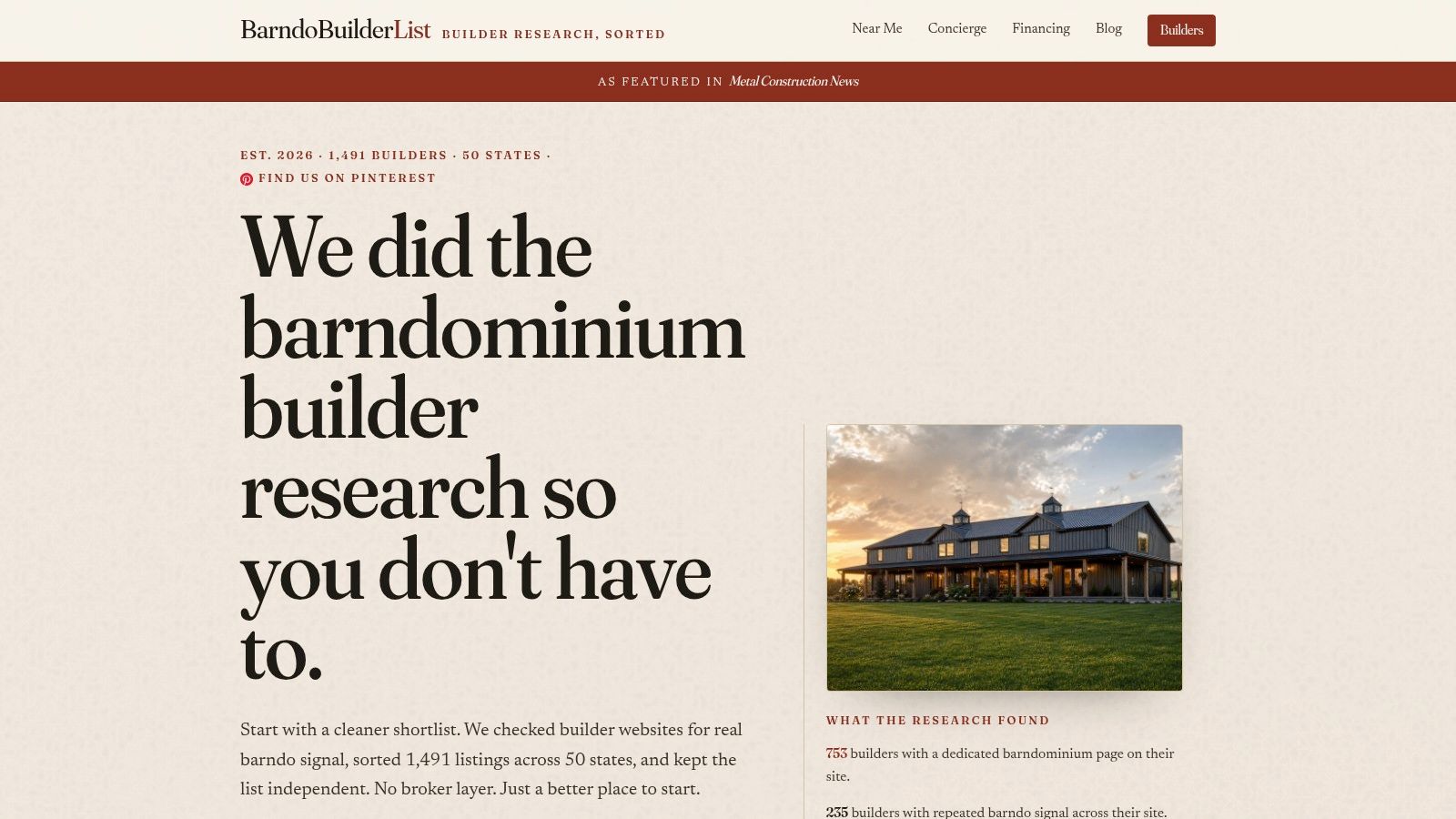
BarndoBuilderList is best understood as a shortlist-building tool, not a construction company. It crawls builders' own websites and organizes companies whose pages show a clear barndominium signal, such as dedicated pages, repeated service references, or a direct mention. The directory uses state and ZIP searches to help buyers move from an unstructured web search toward candidates that appear relevant to the project.
Its profiles can include focus notes, shell-versus-turnkey tags, review snapshots, and links back to the builder's source pages. The site also provides buyer guides covering financing basics, turnkey and shell distinctions, and questions to ask before requesting quotes. A rotating discovery feature highlights a researched profile from each state, while a concierge outreach option can contact researched builders and connect a buyer when a company confirms interest.
What the directory helps you verify first
The main advantage is prioritization. A buyer can identify companies near a required location, see why each company was included, and then inspect the builder's own claims rather than relying on a generic popularity list.
The directory is independent and doesn't function as a broker or quoting platform. That distinction matters. A strong listing suggests that the builder's website contains relevant evidence, but it doesn't prove licensing, insurance, workmanship, code compliance, pricing, or availability.
Practical rule: Treat directory placement as a reason to make a call, not as a reason to skip due diligence.
BarndoBuilderList also has limits. Builders with weak or outdated websites may be missed even when they have relevant experience. Public review information can help surface promising candidates, but buyers still need to request recent references, confirm the exact scope, and ask who is responsible for foundation, thermal-envelope work, interiors, and permits.
For buyers comparing post-frame building companies across unfamiliar markets, the directory's value is efficiency. It narrows the first search and makes the next questions clearer. It doesn't replace a bid comparison or an independent credential check.
2. Morton Buildings
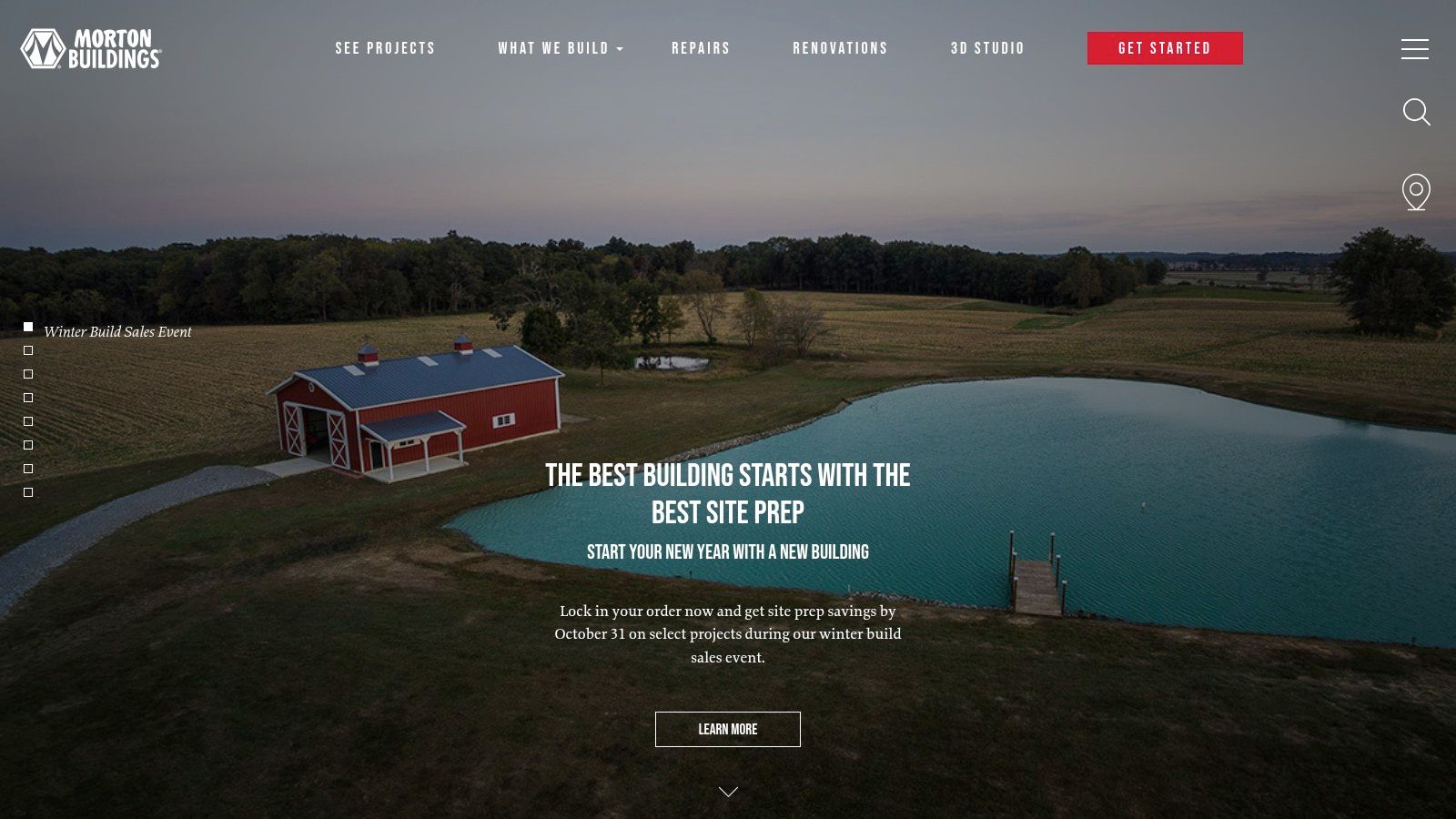
Morton Buildings is one of the most recognizable U.S. names in post-frame construction. Its portfolio spans agricultural buildings, shops, garages, and custom post-frame homes, so it can be a logical candidate when the project combines living space with a substantial workshop, storage area, or working structure.
The company emphasizes engineered building systems, in-house construction crews, climate-aware assemblies, warranty support, and local sales offices. That local sales structure is important because the same concept can require different site preparation, structural details, and code coordination depending on where the building will stand.
Morton doesn't publish a universal online price list. Quotes are developed locally, and buyers should expect the estimate to reflect site conditions and regional requirements rather than a standardized web price. That creates less early price transparency, but it can produce a more project-specific discussion.
Shell strength and interior boundaries
Morton's public materials are strongest around the building system and shell. Buyers considering a residence should ask whether the proposal includes insulation, interior walls, mechanical systems, plumbing, electrical work, drywall, cabinets, flooring, and final inspections. A shell can look complete from the outside while leaving substantial construction responsibility with the owner or a separate general contractor.
Use Morton's barndominium cost guide to frame the questions you take to a local office, then request a written scope from Morton itself. The useful comparison isn't just "Morton versus another builder." It's foundation, erection, envelope, openings, utilities, and finish work against the same categories from competing bids.
Morton's in-house crew model may appeal to buyers who want fewer handoffs during shell construction. It may be less convenient for someone seeking a single turnkey residential contractor unless the local office confirms that arrangement in writing.
3. Lester Buildings
Lester Buildings combines manufacturing, engineering, design resources, and a broad dealer network. Its offerings cover residential projects, hobby buildings, agricultural structures, and commercial facilities, including shouse and barndominium shell concepts.
The MyLester design tools and downloadable plan ideas can help buyers turn a vague concept into a more useful preliminary brief. A floor plan, door schedule, span requirement, and intended use give a dealer something concrete to review. They also make it easier to compare whether two builders are pricing the same building or merely similar-looking exteriors.
Dealer network, local execution
Lester's company-backed engineering gives the system a consistent technical foundation, while local dealers handle the customer relationship and project execution. That combination can expand geographic availability, but it also makes local verification essential. The dealer's service area, crew arrangement, permit role, and finish scope may determine the actual experience more than the national brand name.
A common fit is an owner who wants an engineered shell and has already identified a local general contractor for the residence or interior. A less obvious fit is a buyer who assumes that a national manufacturer-builder automatically provides complete interior construction. Ask directly whether the local proposal includes the thermal envelope, air barrier, insulation, plumbing, electrical, heating and cooling, drywall, and finish work.
Lester's online planning resources are useful for design development, but they shouldn't be treated as a quote. Dealer pricing varies with region, site conditions, specifications, and scope. Before comparing the number, ask each candidate to identify what happens after the shell is erected and who owns coordination between the post-frame crew and interior trades.
4. Wick Buildings
Wick Buildings presents post-frame construction as a flexible option for agricultural buildings, commercial structures, equestrian facilities, suburban buildings, and pole-barn homes. Its residential content is particularly useful for buyers who need to test the concept against their actual project rather than assume that a barndominium is automatically cheaper.
The company provides planning resources, home plans, engineering, and a vetted builder network. It also explains the difference between the building shell and interior completion, a distinction that deserves more attention than most builder roundups give it.
A useful reality check for residential buyers
Wick's guidance says the advantages of a barndominium can diminish when the shop or garage component is modest or when a basement is required. It also explains that interior finishes remain comparable to those in conventional home construction. That framing helps buyers evaluate the whole project instead of focusing only on the post-frame shell.
The company has delivered over 80,000 buildings, according to its website, but that broad delivery history shouldn't be confused with a guarantee that a particular dealer handles turnkey residential work. Coverage is primarily Midwestern, and interiors are often coordinated by the owner or an outside general contractor.
The cheapest shell isn't necessarily the lowest-cost completed home. The missing scope usually appears in insulation, mechanical work, finishes, permits, or site coordination.
Wick may be a strong starting point for buyers who want educational material before contacting a builder. Its regional orientation can be a limitation outside its active network. Confirm whether the local builder will manage the project beyond erection and whether the proposal includes the details required for residential occupancy.
5. FBi Buildings
FBi Buildings serves a predominantly Midwestern market and offers custom engineered post-frame buildings for residential, agricultural, and commercial use. Its barndominium planning content focuses on practical sequencing, including site preparation, permits, design development, and expected construction stages.
That educational emphasis is valuable because many project failures begin before the crew arrives. A buyer who hasn't confirmed driveway access, drainage, foundation requirements, utility routes, zoning, or permit responsibility may receive a shell quote that doesn't reflect the actual work required on the property.
Strong regional fit, limited turnkey assumption
FBi's in-house engineering and regional crews make it worth considering for buyers inside its service area. Its materials can also help a first-time buyer understand what must happen before erection. However, the company generally shouldn't be assumed to act as the general contractor for every interior trade.
Ask whether the local team handles permit submissions or only provides drawings and technical assistance. Then ask whether site preparation, excavation, concrete, insulation, plumbing, electrical, heating and cooling, drywall, and final finishes are included. Those answers should appear in the written proposal, not remain informal assumptions from a sales conversation.
For an initial local search, use nearby builder listings to identify candidates before confirming FBi's current service area. The relevant comparison is between FBi's regional scope and other builders who can realistically mobilize to the same property.
FBi is likely a better fit for an owner who values a structured shell process and regional construction guidance than for someone seeking a nationally standardized turnkey home package. The right conclusion depends on the local office and the requested scope.
6. Cleary Building Corp.
Cleary Building Corp. stands out because it can serve two very different buyer profiles. It offers company construction crews and installed building packages, but it also provides material-only options for owner-builders, local erectors, and general contractors who want to control part of the construction process themselves.
That flexibility expands the potential service area and project types. Cleary's portfolio includes residential, agricultural, and commercial buildings, and its branch network gives buyers a local contact for discussing design, engineering, and installation.
Material-only versus managed construction
Material-only delivery changes the buyer's responsibilities substantially. The purchaser may need to arrange foundation work, labor, equipment, permits, insulation, utilities, and all interior finishes. Freight, unloading, storage, local code changes, and field coordination also need to be addressed before the kit or materials are ordered.
An installed package can reduce some of that coordination, but it doesn't automatically mean turnkey residential completion. Ask the branch to identify every trade included after the frame and exterior are finished. If the buyer plans to use a local general contractor, require a clear handoff point and confirm which party supplies drawings, engineering documents, change orders, and inspection support.
Cleary's broad presence is useful for buyers who want a repeatable post-frame system with local branch support. Its online pricing isn't sufficiently uniform to replace a project quote, so compare scope rather than advertised package language. A material-only proposal and a fully erected shell aren't equivalent bids, even if the dimensions and exterior colors match.
7. Walters Buildings
Walters Buildings takes a shell-first approach while offering selective turnkey options in some locations. Its work includes homes, shops, agricultural buildings, and equestrian projects, making it particularly relevant to buyers who need a substantial working structure rather than a conventional house with a decorative barn exterior.
The company promotes fixed-price contracting through its pricing process and offers pre-engineered “Specials” packages intended to simplify certain building choices. Those features can help buyers control scope, but the contract still needs careful review. A fixed price is only useful when the included work, allowances, exclusions, site assumptions, and change-order rules are clear.
Where Walters fits best
Walters is strongest for buyers who appreciate a defined shell package and want candid guidance about whether turnkey service is available in their location. Its agricultural and equine experience may also matter when the project includes specialized doors, clearances, ventilation, stalls, storage, or durable working surfaces.
Turnkey availability can be location-dependent. Don't treat a turnkey example from another market as proof that the same local office will manage interior construction. Ask for the local division's exact role and identify who handles insulation, moisture control, residential code coordination, utilities, interior finishes, and final completion.
Pre-engineered packages may reduce design complexity, but they can also constrain customization. Review structural spans, openings, roof geometry, insulation requirements, and future expansion needs before selecting a package. Walters can be a good comparison candidate when cost control and shell clarity matter more than a single-company residential finish.
8. Pioneer Pole Buildings
Pioneer Pole Buildings is a Mid-Atlantic-focused builder serving residential garages and shops, agricultural storage, and commercial post-frame structures. Its defined service-area pages are useful because geographic fit is one of the easiest factors for buyers to overlook when browsing attractive project galleries.
The company describes an in-house design-to-build structure and maintains a commercial division for larger or more specialized work. Its quoting process includes a site-visit workflow, which can help surface access, grade, drainage, foundation, and local permitting issues before a proposal is finalized.
Regional specialization over national reach
Pioneer's strength is regional familiarity in Pennsylvania, New Jersey, Delaware, Maryland, and nearby markets. That doesn't make it a national option, but it may make the company more relevant than a larger brand that has no active crew or local office near the property.
Buyers should ask whether permit assistance is included or billed separately in their jurisdiction. They should also confirm who performs excavation and concrete work, whether the company installs the full thermal envelope, and whether residential interiors fall inside or outside the contract.
The company can be a practical candidate for a buyer who wants an installed post-frame structure and a local design conversation. It may be less suitable for someone outside its normal footprint or for an owner-builder seeking a shipped kit. Review the service-area map and request a scope that distinguishes erection from full residential completion.
9. Hansen Pole Buildings
Hansen Pole Buildings is an online-first supplier of custom post-frame kits shipped across the country. Its model differs entirely from an installed builder. Hansen can support design, plans, materials, and planning questions, but the buyer generally arranges labor, foundation work, permitting, utilities, insulation, and finishes.
That approach can work well for an experienced owner-builder or a general contractor who already has local trades. It can also create substantial coordination risk for a homeowner who has never managed excavation, concrete, structural erection, electrical, plumbing, or residential inspections.
Transparent early pricing, broader final responsibility
Hansen publishes kit pricing examples and sale packages, which can make early budgeting easier than with builders that only provide custom quotes. Those figures describe the kit or material package, not the completed building. Freight, local code upgrades, foundation design, labor, equipment, weatherproofing, insulation, and interior work can materially change the total project cost.
Ask for a line-by-line description of what arrives in the package and what doesn't. Confirm whether engineering documents match the local jurisdiction, who modifies the design for site-specific requirements, and whether a local erector is available or must be sourced independently.
Hansen is a logical comparison when the buyer wants control and has reliable local help. It isn't a substitute for an installed post-frame contractor. The right comparison is kit plus local construction management versus a builder's erected-shell or turnkey proposal, with every excluded responsibility listed in writing.
10. National Barn Company
National Barn Company operates through regional divisions in Eastern and Central U.S. states. Its portfolio includes custom barns, garages and shops, equestrian facilities, and other post-frame structures, with a design-to-construction workflow that varies by division.
The company states that it has built more than 18,000 buildings across 27 states since 1992, according to its website. That is an attributed company claim, not an independent quality rating. It indicates a large stated experience base, but buyers still need to evaluate the local division, crew, contract, and scope.
Division coverage matters more than the national name
National Barn's regional structure can give buyers an efficient intake process and access to varied project examples. It also means that service area, scheduling, pricing, and turnkey availability may differ by division. A portfolio image from one state shouldn't be treated as evidence that the same scope or construction team serves another property.
Use the farm and ranch builder listings to identify other candidates with comparable agricultural or rural-building signals, then confirm which companies work in the required ZIP code. National Barn's quick-quote process may help establish feasibility, but the resulting proposal should separate design, foundation, site work, erection, insulation, utilities, and interior completion.
The company may suit a buyer who wants an installed building within its division footprint. It won't automatically be the best fit for a project outside those maps or for a buyer who needs a completely turnkey home without coordinating additional trades. Request the local division's written scope before treating the brand's broad reach as a project advantage.
Top 10 Post‑Frame Building Companies Comparison
| Provider | Core offering | ✨ Unique features | 👥 Target audience | 💰 Price/value | ★ Quality/trust |
|---|---|---|---|---|---|
| BarndoBuilderList 🏆 | Evidence‑first nationwide directory; state & ZIP search; concise builder profiles | Rotating discovery index; free concierge outreach; confidence tiers; buyer guides | Homebuyers & DIYers starting a defensible shortlist | 💰 Free-to-start research & concierge; not a quoting platform | ★★★★★ (ranked by website signal) |
| Morton Buildings | Engineered post‑frame shells with in‑house crews; national + local offices | Long warranties; model shell concepts; local code/climate quoting | Buyers wanting company-built shells and quality control | 💰 Custom local quotes; no online price lists | ★★★★ Consistent company crews |
| Lester Buildings | Manufacturer-builder with MyLester design tools & plan sets; dealer network | Downloadable plan concepts; company-backed engineering | Buyers seeking pre-design resources via dealers | 💰 Pricing varies by dealer; limited upfront transparency | ★★★★ Established (since 1947) |
| Wick Buildings | Company engineering + vetted builder network; residential focus | Transparent cost guidance; residential planning guides | Midwest buyers & first-time barndo shoppers | 💰 Regional quotes; shell-focused (interiors often separate) | ★★★★ Strong educational resources |
| FBi Buildings | Custom engineered post‑frame shells; permit & site-prep assistance | Step-by-step planning guides; timeline expectations | Midwest homeowners needing permit and sequencing help | 💰 Regional quotes; typically not full turnkey | ★★★★ Good timeline & process guidance |
| Cleary Building Corp. | Branch-based manufacturer-builder offering turnkey or material-only | Material-only option for owner-builders; wide branch network | Owner-builders or buyers wanting flexible supply/build options | 💰 Quotes required; variable online pricing | ★★★★ Broad U.S. presence |
| Walters Buildings | Engineered shells with fixed-price offerings and "Specials" | Proprietary fixed-price software; pre‑engineered Specials | Midwest buyers seeking cost control and predictability | 💰 Fixed-price where available; regional limits | ★★★★ Cost‑control focus |
| Pioneer Pole Buildings (PPB) | Regional design‑to‑build pole‑barns with in‑house crews | Clear service-area pages; streamlined quoting & FAQs | Mid‑Atlantic homeowners, farms, shops | 💰 Regional quotes; will quote outside core footprint | ★★★★ Strong local reputation |
| Hansen Pole Buildings | Nationwide kit supplier: live kit prices, shipping, plan support | Transparent online pricing, sale packages, kit planning guides | DIY owner‑builders or buyers pairing kit with local GC | 💰 Kit pricing shown; buyer handles labor, permits & upgrades | ★★★★ Transparent kit pricing |
| National Barn Company | Design‑to‑construction regional divisions; large portfolio | Quick‑quote intake; varied add‑ons and testimonials | Eastern/Central buyers needing regional builder workflow | 💰 Custom quotes; price transparency limited | ★★★★ Large experience base (thousands built) |
Turn This List Into a Defensible Shortlist
Start with the property, not the brand. Identify the required state and ZIP code, then remove companies that can't clearly serve that location. A national website doesn't prove local availability, and a regional builder may be the stronger choice if it has nearby crews, local code familiarity, and a clear process for site visits.
Next, define the delivery model. Decide whether you need a material-only kit, an erected shell, a partially completed structure, or a turnkey partner. These are different purchases. A kit may leave the buyer responsible for labor, foundation, permitting, utilities, insulation, and finishes. An erected shell may still exclude the entire interior. A turnkey proposal may include more coordination, but you need to verify exactly which trades and inspections are covered.
The shell-versus-turnkey distinction is where many comparisons fail. Neutral buyer guidance recommends asking who handles the thermal envelope, air barrier, moisture control, residential code coordination, permits, and local licensing and insurance before comparing bids. The same exterior can conceal major differences in insulation, drywall, plumbing, electrical, and finish responsibility, which can create delays or unexpected costs. See this shell-versus-turnkey guidance before you request proposals.
Build the same scope for every quote
Give each appropriately matched candidate the same basic information:
- Site conditions: Share the property location, access constraints, grade, drainage concerns, utility plans, and known zoning requirements.
- Structural requirements: Specify dimensions, clear heights, spans, doors, windows, lofts, mezzanines, future expansion, and intended residential or working use.
- Foundation responsibility: Ask who designs, permits, excavates, forms, pours, inspects, and warrants the foundation or slab.
- Building envelope: Identify insulation, vapor or air control, weather protection, interior lining, windows, doors, and thermal requirements.
- Interior completion: List electrical, plumbing, heating and cooling, drywall, cabinets, flooring, fixtures, and final inspections separately.
- Project management: Confirm who coordinates subcontractors, handles change orders, schedules inspections, and resolves defects.
Compare at least two or three candidates that match the same service area and scope. A kit supplier shouldn't be compared directly with a turnkey general contractor unless you calculate the local labor and trade responsibilities that the kit excludes. Likewise, a shell specialist shouldn't lose a comparison just because another proposal bundles interior work into a larger number.
Check references independently. Ask for projects with similar use, location, size, structural requirements, and completion scope. Verify credentials, insurance, licensing requirements, permit responsibility, warranty terms, and the identity of the contracting party. Website signal, review snapshots, and directory placement can prioritize calls, but they aren't proof of workmanship or contractual performance.
The post-frame sector now spans more than agricultural structures. A 2024 industry survey found that firms primarily focused on post-frame work reported serving single-family residential projects at 61.1%, agricultural work at 61.1%, and commercial construction at 44.4%. The same survey placed 30.1% of firms in both the South and Midwest, with 20.6% in the East and 12.3% in the West. The survey data supports a broad market, but it doesn't tell you which company can deliver your exact project.
The category's history explains that range. Post-frame systems began as “pole buildings” in the 1930s, primarily using pressure-treated round wood posts for agricultural and small accessory structures. By the late 1970s through the mid-1980s, the system had developed into a more engineered approach, and diaphragm design methods in the 1980s through the mid-1990s improved structural efficiency and helped expand use into commercial and residential markets. The National Frame Builders Association history provides the background, but today's buyer still needs project-specific engineering and code confirmation.
For the first search, use BarndoBuilderList's state and ZIP tools, scope tags, source links, and buyer questions to create a defensible shortlist. Then contact the builders directly with the same written brief and judge the responses by clarity, local fit, documented scope, and willingness to identify exclusions.
BarndoBuilderList helps buyers find barndominium-friendly and post-frame building companies by state or ZIP, review observable website signals, and compare scope notes before outreach. Visit BarndoBuilderList to build a cleaner local shortlist, then use its source links and buyer questions to verify each candidate independently.
- post frame building companies
- pole barn builders
- barndominium builders
- post frame construction
- builder directory