Contractor License Requirements: A 50-State Guide
Learn contractor license requirements across all 50 states, including experience rules, exams, bonds, and verification steps for your barndominium project.
You're standing on a dirt lot with a sketch in your hand, two bids in your inbox, and one big question that keeps getting bigger. One builder says they're fully licensed, bonded, and ready to pull permits. The other says licensing isn't required where they work, and their number is lower.
That's the moment where contractor license requirements stop being paperwork and start being a buying decision. If you're shopping for a barndominium, you're not just hiring someone to frame walls. You're deciding who can legally touch the slab, who can pull the permit, who carries the liability if something goes sideways, and whether the price you're comparing even covers the same scope of work.
Table of Contents
- Why Contractor License Requirements Matter for Barndominium Buyers
- The Building Blocks of a Contractor License
- How States Differ on Licensing and Reciprocity
- Thresholds That Trigger a License on a Barndominium Project
- How to Verify a Builder's License Before You Sign
- Shell Versus Turnkey and What Each Requires
- Common Misconceptions Buyers Should Drop
- Your Next Steps and Where to Verify
Why Contractor License Requirements Matter for Barndominium Buyers
A rural buyer comparing two bids for a 2,400-square-foot barndominium usually thinks the difference is price. It isn't. The primary difference is often risk, permit authority, and whether the people on site are authorized to do the work they're quoting.
A licensed general contractor can usually pull permits, coordinate inspections, and carry the project as a legally accountable entity. A crew that says licensing isn't required in their state may still be fine for a narrow scope, but that doesn't make the bid comparable. If they can't legally handle the slab, the framing, or the utility tie-ins, you're the one left sorting out the gap between the shell and the finished house.
Practical rule: if a builder can't explain exactly which license covers the exact scope you're buying, the bid is too vague to trust.
The hidden costs show up later. An unpermitted slab can stall the build before the shell ever arrives. A mismatch between the builder's license and the work they're performing can complicate insurance claims, delay lender sign-off, and force you to hire a second contractor to clean up the mess.
The buyer-side lesson is simple. Contractor license requirements are not about bureaucracy for its own sake. They're a filter that helps you separate a real project team from a cheap-looking quote that leaves you holding the bag once the first inspection fails.
The Building Blocks of a Contractor License
A contractor license is the credential that tells you who can legally take charge of a build, and what kind of work they are allowed to perform. On a barndominium project, that matters fast, because a shell package, a turnkey build, and a trade-only scope do not call for the same credentials.
Classifications, experience, exams, and financial backing
The first building block is the classification. Some licenses cover general building, others cover specialty trades such as plumbing, electrical, or mechanical work. That distinction matters on a barndominium because a shell-only package and a full turnkey build require different authority on the jobsite, and the person quoting the work needs to match the scope you are buying.
The second block is experience. States do not hand out licenses to people who have only watched jobs from the truck. California, for example, requires four years of journey-level experience within the last 10 years for many classifications, and other states commonly set experience rules in the 1 to 5 year range, according to statewide licensing guidance and industry summaries. California also requires a Law & Business exam plus a trade exam, fingerprinting, and a $25,000 contractor bond for active licenses, which shows how seriously the state treats entry into the trade. California licensing summary with bond update and exam pass-rate range, California licensure process overview, California contractor license process and bond requirements
The third block is the exam. A trade exam checks whether the contractor understands the work itself. A business and law exam checks whether they understand contracts, lien rules, compliance, and project management well enough to stay out of trouble. That is not a perfect shield for the buyer, but it does separate credentialed operators from the builder who can sell a job and little else.
The fourth block is financial assurance. Bonds and insurance are different tools. A surety bond gives the buyer a financial backstop if the contractor fails to meet obligations, while insurance is meant to cover certain losses during the job. California's $25,000 bond is a clear example of how states use financial security to protect the public. California bond and licensure details
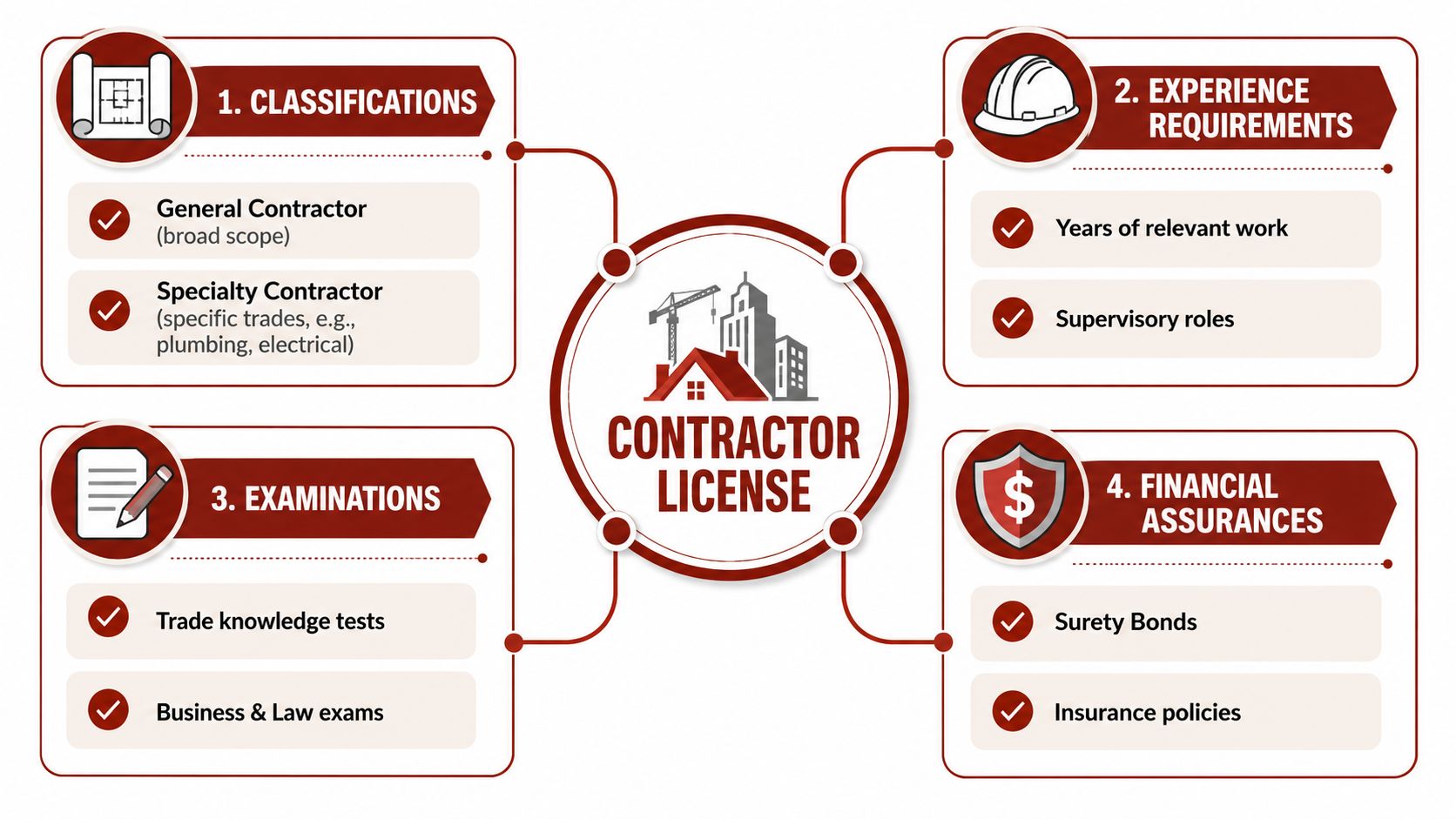
Buyer takeaway: a license is a mix of scope, experience, testing, and financial accountability. If one of those pieces is missing, the license does not tell you much about the builder's ability to carry your project safely from permit to final inspection.
How States Differ on Licensing and Reciprocity
A barndominium buyer cannot treat licensing as a single national rulebook. States split the job up differently, and that changes who you should verify before you sign. In some places, the state licenses the contractor directly. In others, the state steps back and local governments, trade boards, or registration rules do the policing. That difference matters because the builder's paperwork has to match the place where your permit is pulled and the work is done.
What "No State License" Means in Practice
Texas is the clearest example of a state without a statewide general contractor license. That does not mean the job is unregulated. It means the buyer has to check city and county rules, local permit requirements, and any insurance or registration standards before work starts. Pennsylvania works differently, with statewide registration for certain home improvement work even though it does not issue a general contractor license in the same way as licensed states. For a buyer comparing bids, the point is simple, “no state license required” is not the same as “no regulation.” If you are comparing builder budgets by geography, the barndominium cost by state guide helps explain why local compliance can change the project cost.
Reciprocity adds another layer. A contractor licensed in one state may still need to register, show insurance, or satisfy local rules before crossing a border and starting work. Reciprocity can reduce paperwork, but it does not erase permit checks or local oversight. A builder saying they have “worked in neighboring states” is not enough proof that they can pull your permit where your barndominium is going up.
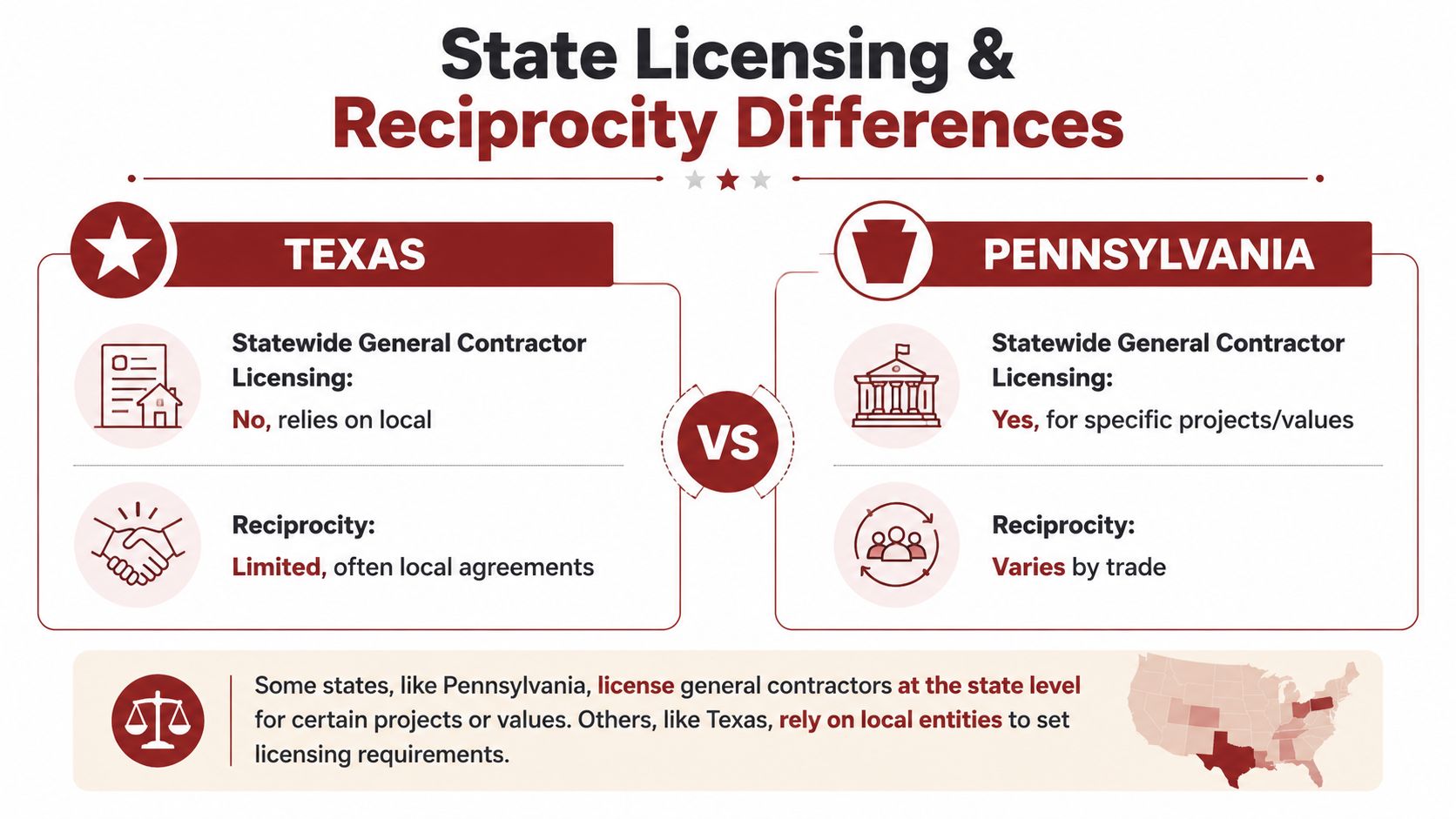
A buyer should ask three direct questions. Where is the builder legally licensed, what does the project site require, and does the builder's paperwork match the jurisdiction handling your permit. A state with no general contractor license can still have strict oversight if the county, city, or trade board says it does.
Thresholds That Trigger a License on a Barndominium Project
A barndominium buyer can get burned by a simple assumption, that a small-looking project does not need a licensed contractor. California shows why that thinking fails. Work valued at $1,000 or more, or work that requires a building permit, generally has to be done by a licensed contractor there. That matters on barndominiums because a shell package can cross the line once labor, materials, and permit-triggered work are bundled together. California contractor threshold and project trigger rules
Why barndominium scopes trip licensing rules fast
A barndominium project almost never stays in one clean bucket. Site prep, slab work, the metal shell, utility rough-ins, insulation, interior framing, and finish work are often priced separately, then rolled into one total. Once that happens, thresholds tied to total project cost, permit requirement, or trade type can apply much sooner than buyers expect.
A shell-only quote and a turnkey quote should never be judged the same way unless you know who is licensed for each part of the job. In one state, the trigger may be a low dollar threshold. In another, the deciding factor may be whether the work needs a building permit. In another, a specialty trade license may matter more than the general contractor badge.
| State | Trigger | Experience | Bond / Insurance | Exam |
|---|---|---|---|---|
| California | $1,000 or permit-triggered work | 4 years journey-level experience within the last 10 years | $25,000 bond | Law & Business exam plus trade exam |
| North Carolina | $40,000 project value | Not stated in the verified data as a fixed number, but qualification is required | Financial responsibility or surety bond depending on tier | NASCLA-accredited building exam or state trade exam, plus business and law exam |
| Tennessee | $25,000 or more before bidding or negotiating | Proof of experience required | Financial statement required | Business & Law exam, and trade exam when applicable |
| South Carolina | $5,000 for residential new construction, repair, or improvement of single-family homes | 2 years relevant experience | Financial responsibility through documentation or bonding | Trade exam plus business and law exam |
The table makes the point plainly. Your barndominium can trigger a license rule because of money, permit status, or the type of work, not just because of the builder's title. If your project includes a slab, a shell, and utility work, assume it will fall inside a licensing trigger somewhere.
How to Verify a Builder's License Before You Sign
Do not take a glossy website or a sales rep's word for it. Ask for the license number, then verify it yourself on the state board's site. If the builder hesitates, stop there. That hesitation tells you more than a polished pitch ever will.
A fast verification routine that actually works
Start by checking the license number and the exact legal name on the board record. The name on the quote, the contract, and the license should line up. If the company name is different from the license holder, find out why before money changes hands.
Next, confirm the classification matches the scope. A general building license is not the same thing as a specialty trade credential, and a state registration is not the same thing as a full general contractor license. Then ask for the current certificate of insurance and verify it directly with the insurer, not just by staring at a PDF someone emailed you.
You should also ask for proof of the bond if the state requires one, and then cross-check permit history if the builder has past local projects you can identify. Closed permits matter because they show the contractor has taken jobs through inspection, not just sold work from behind a desk.
- Check the status: confirm the license is active, not expired, suspended, or revoked.
- Match the scope: make sure the classification fits your shell, slab, or turnkey package.
- Confirm insurance: request certificates for general liability and workers' compensation where applicable.
- Cross-check permits: ask how the builder handled past inspections and final sign-off.
- Watch for red flags: mismatched names, out-of-state paperwork with no local authority, or a builder who can't explain their license class.
A builder who won't give you clean verification documents is telling you they don't want scrutiny. That's not a good sign.
If you want a second list of screening questions after the license check, use these questions to ask a barndominium builder before you sign.
Video walkthrough of contractor license verification
Shell Versus Turnkey and What Each Requires
Shell and turnkey aren't just different prices. They're different compliance footprints. A shell package usually leans on a metal building erector, maybe a foundation contractor, and sometimes one or two specialty trades. A turnkey package usually brings in a general contractor plus subs for plumbing, electrical, HVAC, insulation, drywall, and finish work.
Why the scope changes the license checklist
If you're buying shell-only, don't assume the license conversation is over. You still need the permit path figured out, and in many jurisdictions the foundation contractor needs the right classification to touch the slab. Even if the shell crew is competent, the project can still stall if the site work was never tied to the permit file correctly.
Turnkey creates a wider license and insurance chain. You're no longer vetting one crew. You're vetting the general contractor, then checking whether their subcontractors are licensed for the trades they're performing. That means you should expect more than one license class to appear on the project, especially if the build includes mechanical, electrical, or plumbing work.
The simplest rule is this. The broader the builder's scope, the more credentials you should verify. A shell-only hire may need less in the way of trade coverage, but the moment the job moves into interior completion, the licensing load rises fast. For a buyer sorting options, turnkey barndominium builders near me is the right search when you want one party carrying more of the project risk.
If a builder says they can handle everything, ask whether they're licensed to do everything or just coordinating it. That answer decides whether you're hiring a true contractor or a middleman.
Common Misconceptions Buyers Should Drop
The first myth is that a license guarantees quality. It doesn't. A license says the contractor is legally eligible and has cleared the state's minimum gatekeeping. It does not promise clean workmanship, good communication, or a jobsite that stays on schedule.
The second myth is that no state general contractor license means no consumer protection. Also false. Local permits, trade registrations, and insurance rules still apply in many states, and those local layers can be strict. Ohio is a good reminder that even where statewide general contracting isn't licensed, trade work may still require state licenses and local rules can still control who builds what.
The third myth is that the lowest bid from an unlicensed crew is automatically cheaper. Unpermitted work can create expensive repairs, slow resale, and create problems with claims if the house gets damaged. If a crew skips the legal steps, you may save upfront and pay later in rework, delays, or forced compliance work.
Treat licensing as one signal, not the whole verdict. A licensed builder with weak references is still a risk. An unlicensed builder in a no-state-license jurisdiction may still be acceptable for a narrow task if local rules and insurance check out. The point is to separate legal eligibility from actual performance, then judge both.
Your Next Steps and Where to Verify
Start with a short list of three to five builders who say they handle barndominiums in your state. Pull their license numbers, verify each one on the state or local board site, and ask for current insurance certificates before you talk schedule or price. Then request two recent barndominium references, not generic house references, because scope matters.
Use the next 30 days to do this in order.
- Shortlist builders who work in your county or permit district.
- Verify license status and classification on the board record.
- Request insurance proof and check that the names match.
- Ask about permit history on a recent job.
- Compare shell versus turnkey scope so you know what's included and what isn't.
If you're unsure where to start, go straight to your state contractor licensing board and your local building department. Then cross-reference those rules with a barndominium-friendly shortlist so you're not wasting time on builders whose credentials don't fit your project. The cleanest next move is to verify first, negotiate second, and sign last.
If you want a faster way to narrow the field, use BarndoBuilderList to start with builders already organized for barndominium buyers. It's a practical first pass when you need licensed candidates that fit shell or turnkey scope before you spend a week chasing dead ends.
- contractor license requirements
- state licensing
- barndominium builders
- verify contractor
- general contractor