Z in ZIP Code: Where the Letter Comes From
Wondering about Z in ZIP Code? Learn what the Z stands for, why ZIP codes use only digits, and where the letter Z appears in mail, forms and Census data.
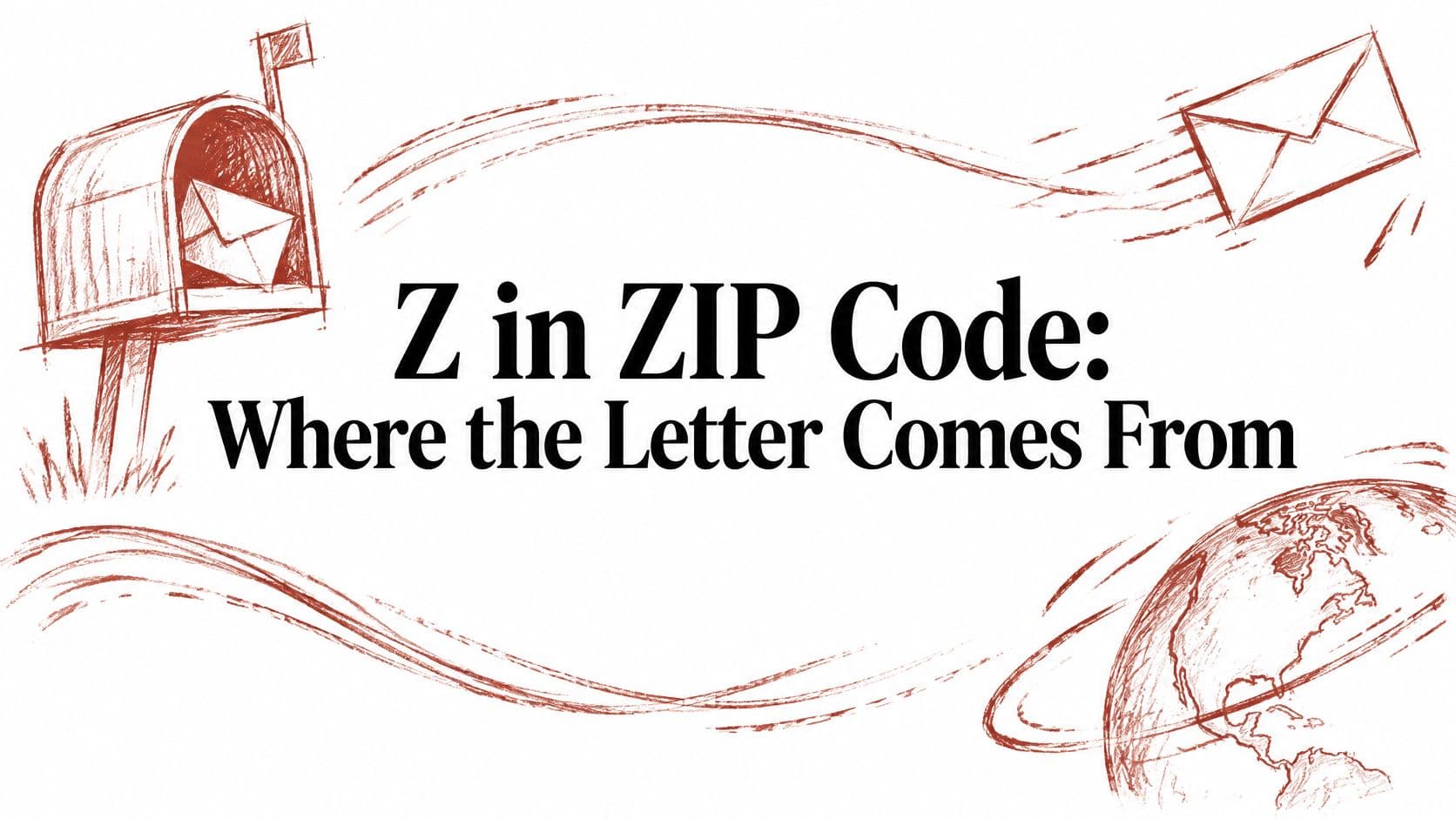
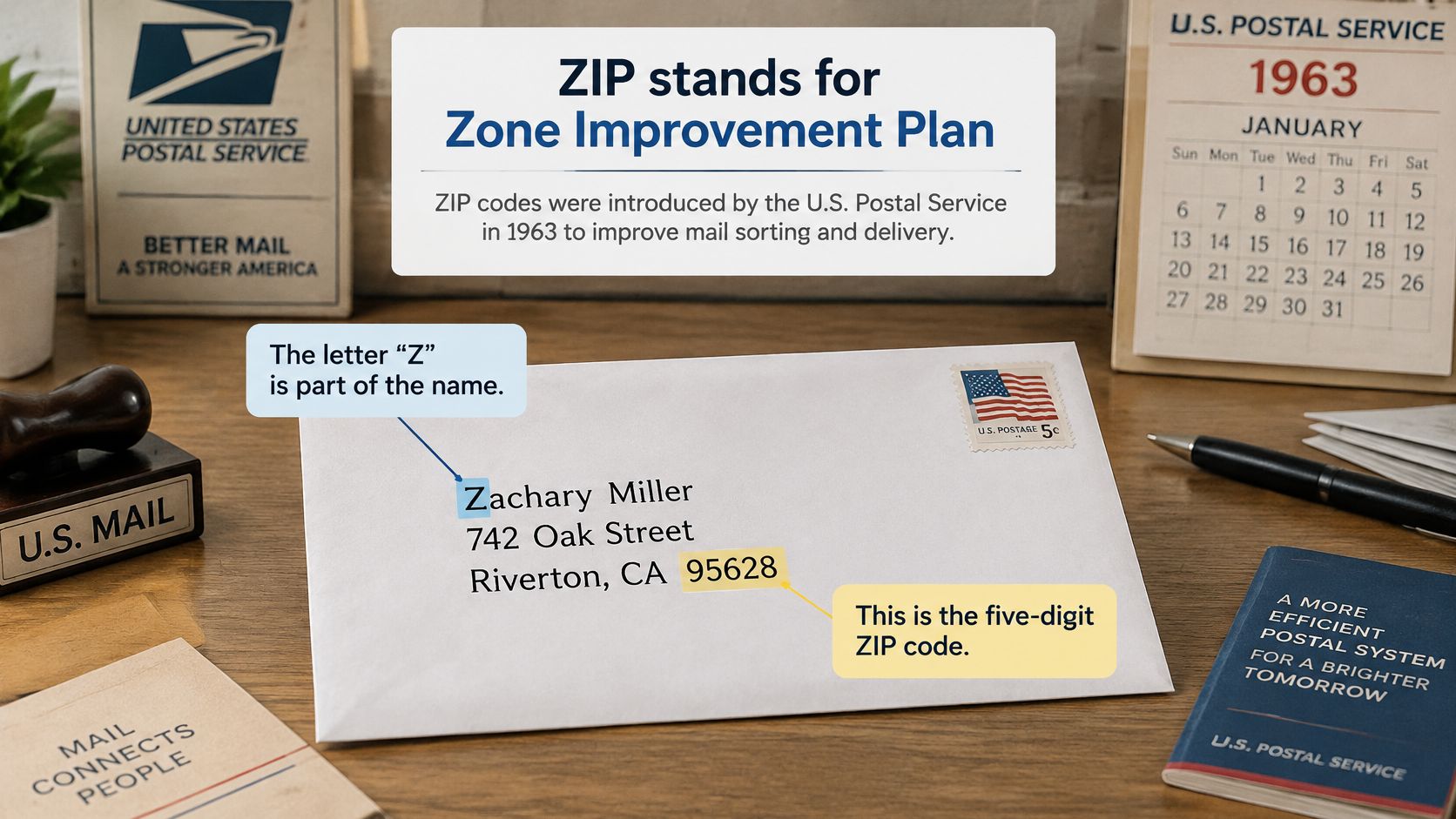
ZIP stands for Zone Improvement Plan, the USPS system introduced in July 1963, and US ZIP Codes contain only digits, so a Z is never part of a valid code. The letter belongs to the name of the system, not to any address printed on an envelope.
Why do so many people treat that five digit string as if it were a precise map boundary? It's a natural mistake, because you type it into weather apps, store locators, and builder searches and get a neat result back. Once you read the Z in ZIP Code as a clue to how the system was built, as a sorting label for moving mail, the confusion around rejected forms, stray letters, and odd search results starts to make sense.
Table of Contents
- Where the Z in ZIP Code Comes From
- Why ZIP Code Fields Accept Only Numbers
- Fixing Z Entries and ZIP Field Errors
- Z as a Placeholder in Forms and Datasets
- The Z in Census ZIP Data
- Verify a ZIP Before Using It to Find Builders
Where the Z in ZIP Code Comes From
ZIP stands for Zone Improvement Plan, and the Z is part of the name, not part of any code. The U.S. Census Bureau geography guidance on ZCTAs notes the U.S. Postal Service introduced the system in July 1963 to improve processing and delivery of a rapidly increasing volume of mail.
Reading the Five Digits as a Sorting Map
Think of the original five digits as nested drawers in a filing cabinet. Each digit narrows the search a step further, from the whole country down to one local delivery area.
- First digit: A broad geographic region, progressing from 0 in the East to 9 in the West.
- Second and third digits: A regional processing area or major sectional center facility.
- Final two digits: A local post office or delivery zone.
That structure tells you what a ZIP Code really is. It's an operational code designed around postal logistics and sorting facilities, not a label drawn to match a town line or neighborhood edge.
The ZIP Plus Four Extension
In 1983, ZIP+4 added four digits after a hyphen. That extension narrows delivery to a smaller segment, such as a group of addresses, one building, or part of a street.
Treat the core code as a region for sorting, not a precise boundary for anything else.
That's why a ZIP works well for estimating proximity and service areas, but you shouldn't assume everyone inside it shares the same city rules, school zone, or contractor travel distance. The Z in ZIP Code points back to zones, and zones were a mail handling idea from the start.
Why ZIP Code Fields Accept Only Numbers
US forms reject letters because the system they check against has no letters to accept. A standard code is five digits, and ZIP+4 is nine digits with a hyphen after digit five. The design is digits-only from the ground up, which is why a Z in a US ZIP field is always an error or a placeholder, never part of a real code.
| Format | Example | Length and characters | Where it applies |
|---|---|---|---|
| Five-digit ZIP Code | 02134 | 5 digits, no letters | Standard US mail addresses |
| ZIP+4 code | 02134-1234 | 9 digits with a hyphen after digit 5 | Delivery to a building, block or street segment |
| Canadian postal code | K1A 0B1 | 6 characters, letters and digits alternating | Canada |
| Census ZCTA | 02134 | 5 digits | Statistical area in Census data, not a mail route |
Why the Field Is Built That Way
A ZIP field works like a keypad that only has number buttons. Sorting equipment and address databases read the code as a numeric routing string, so when a letter appears the form can't match it to any delivery area. It stops you with a validation error instead of passing bad data downstream. That's the form working as designed, not being fussy.
Canada is the common source of confusion. Canadian postal codes mix letters and digits, so a Canadian visitor may reasonably expect letters to be fine. The US system never made that choice. Its codes were built for machines that sort by number, and every digit-only field you meet today inherits that decision.
A Quick Character Check
Before you assume a code is wrong, run three checks in order.
- Count the characters: Five digits for a standard code, or nine digits plus a hyphen for ZIP+4.
- Confirm the hyphen position: In ZIP+4 it sits after digit five, never at the start or end.
- Confirm the country: If the country says United States, letters will fail no matter how correct the code looks.
When all three checks pass and the form still complains, the entry itself is suspect rather than the code. The next step is finding where that stray letter or formatting problem came from.
Fixing Z Entries and ZIP Field Errors
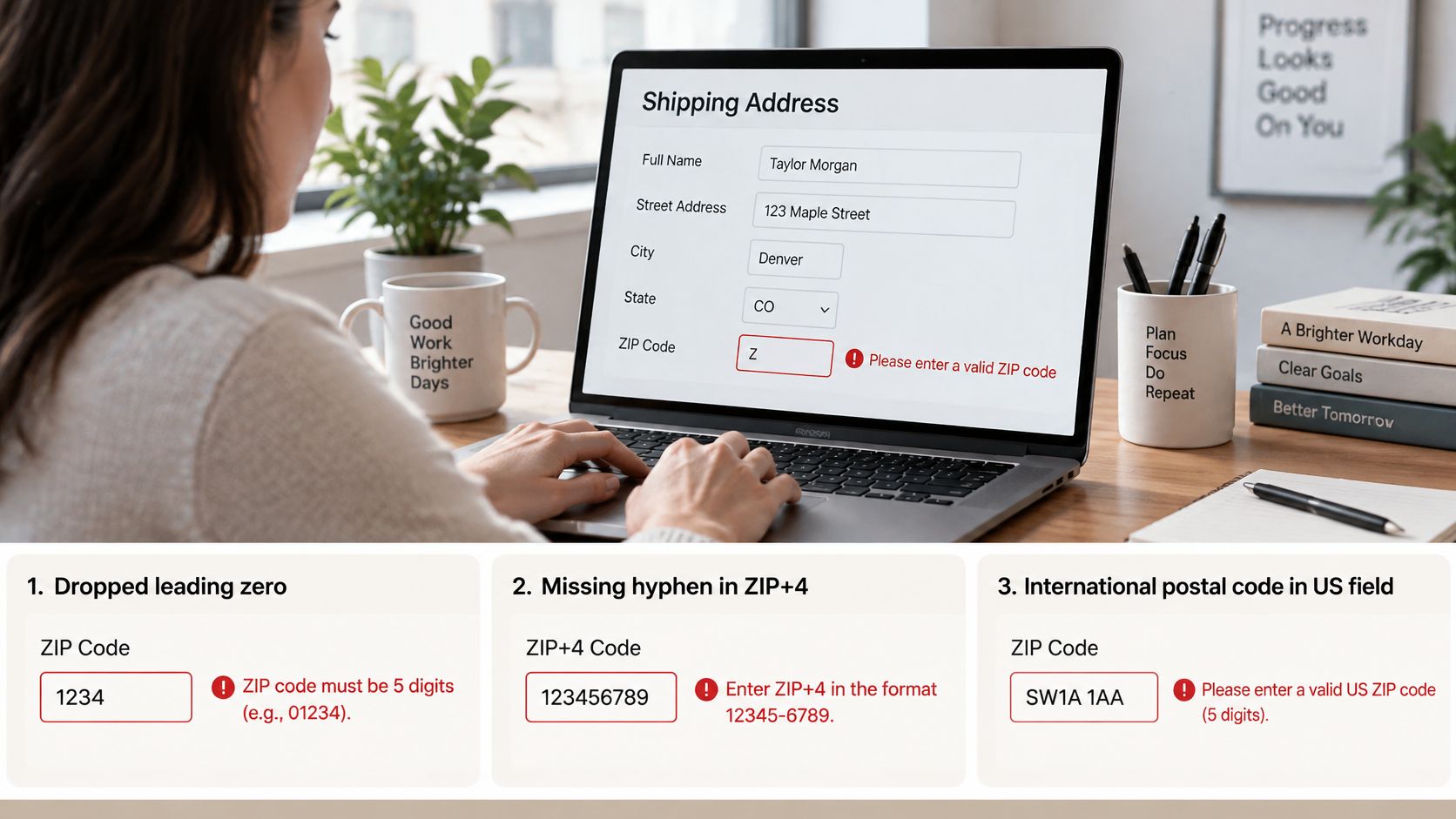
The most common case is simple. You type a Z or another letter into a US ZIP field, the form flags it as invalid, and you can't submit until it's gone.
| Symptom | Likely cause | Fix |
|---|---|---|
| Form says ZIP is invalid after a Z is typed | Letter entered in a numeric US field | Delete the letter and enter five digits |
| Canadian code rejected by a US form | Wrong country selected | Change the country, then enter the postal code |
| Stray Z or character copied from another field | Address pasted with extra text | Remove the extra character and keep only the digits |
The Vanishing Leading Zero
The sneakiest cause has nothing to do with typing. If a spreadsheet stores a ZIP as a number, it drops the leading zero, so 02134 becomes 2134 and every form downstream rejects it as too short.
- Format the column as text before you paste or import ZIP Codes.
- Add an apostrophe before a single entry, such as '02134, to force text handling.
- Re-add the zero manually for any four digit value that's meant to be a Northeast or Puerto Rico code.
Practical rule: If your ZIP starts with 0, treat it as text everywhere, in spreadsheets, imports, and address exports.
Wrong Country and Pasted Text
A Canadian code rejected by a US form is almost always a country mismatch. Switch the country to Canada first, and the same code that failed a second ago will validate, because the form swaps in the Canadian pattern.
Pasted addresses cause the last group of errors. When you copy an address block from an email or invoice, a stray Z or symbol from a neighboring field often rides along. Clear the field completely and type only the digits.
Once the field holds five digits, or nine with a hyphen in the right place, the entry will validate. If it still doesn't, the address itself may not match postal records, and that's a different problem than the Z in ZIP Code misunderstanding.
Z as a Placeholder in Forms and Datasets
Sometimes a Z in a ZIP field isn't a typo. It's a placeholder someone used because the code was unknown or never collected.
You'll meet a lone Z, a run like ZZZZZ, or numeric fillers such as 00000 or 99999. Treat all of them as missing data, not as real postal codes, because none of them routes mail anywhere.
Handling a Placeholder in Five Steps
- Identify it: Look for a value that isn't five digits, or one character repeated across a whole column.
- Check the source: A form may force a filler when a user skips the field, and an export may fill blanks with codes.
- Decide the fix: If you know the address, replace the placeholder with the correct five digit ZIP. If you don't, leave the field blank or mark it unknown instead of guessing.
- Filter in analysis: Exclude placeholder rows from ZIP level counts and distance calculations, because a fake ZIP drops the record into the wrong area.
- Document the gap: Record how many rows lack a valid ZIP so later users know the totals are incomplete.
Say a signup form requires a ZIP, but an international customer doesn't have one. They type ZZZZZ to get past the required field, and now your dataset says they live somewhere that doesn't exist. If you average distances or count customers by ZIP without filtering that row out, your results skew.
A placeholder Z is a data quality flag, never a ZIP Code.
The safest habit is to keep unknown as unknown. A blank field tells the truth. A filler string pretends to.
The Z in Census ZIP Data
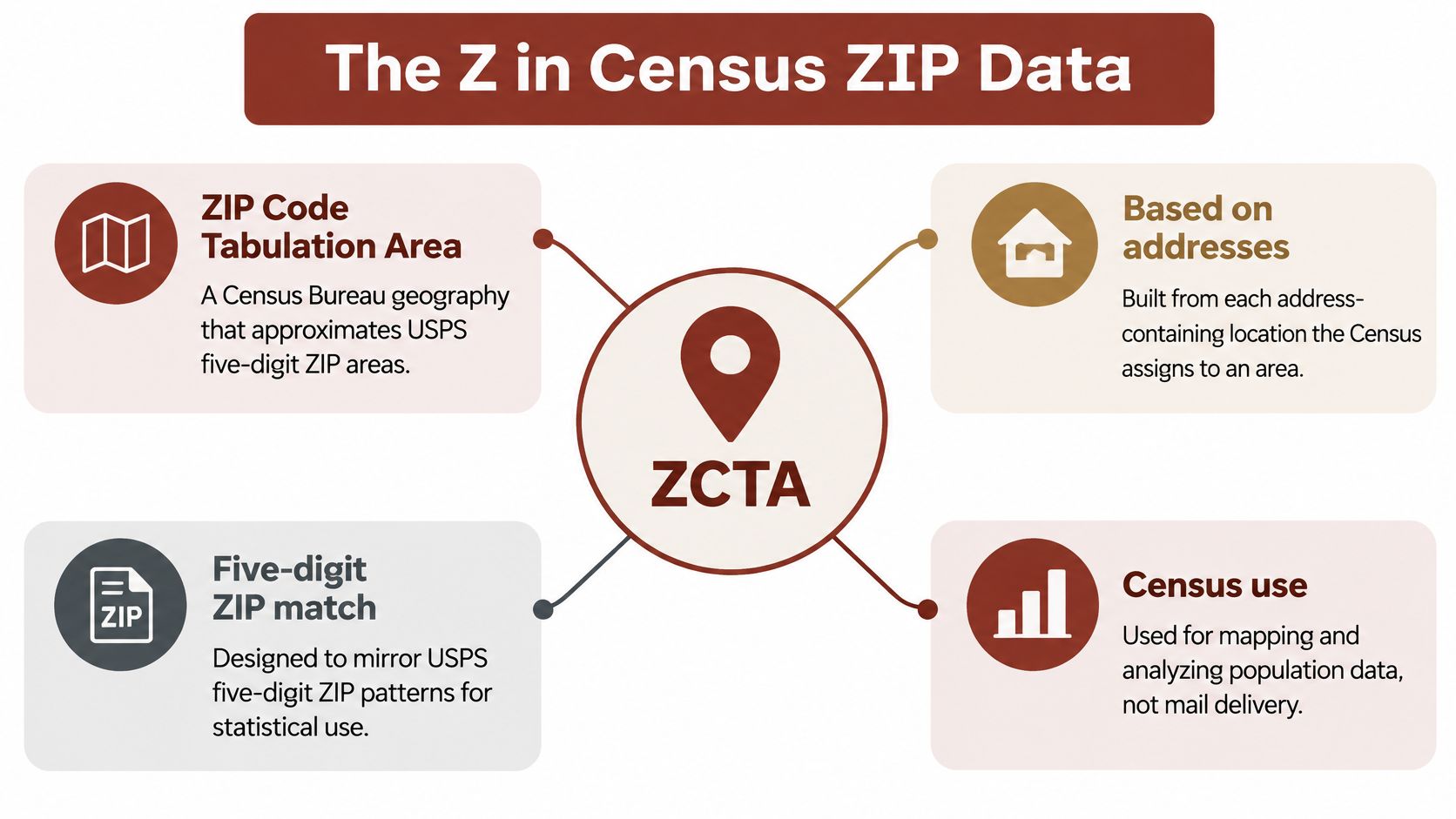
Here's where the Z gains a second life. ZCTA stands for ZIP Code Tabulation Area, a Census Bureau geography built for statistics rather than mail delivery.
Two Things With Similar Names
A ZIP Code is a postal delivery construct. A ZCTA is a generalized areal representation of a USPS five digit ZIP Code service area. The Census Bureau guidance on finding ZIP Code data on data.census.gov explains that ZCTAs are created from Census tabulation blocks rather than copied from postal delivery routes.
The Bureau assigns each address containing block to a single ZCTA, usually the area matching the most frequently occurring ZIP Code among addresses in that block. It then uses surrounding blocks and limited buffering to make a contiguous statistical geography where necessary.
What That Means for Your Numbers
Say you pull a population figure for a ZCTA. That's a statistical estimate for a mapped area. A count of mail routes or delivery points, by contrast, comes from USPS operations. Same five digits, different thing being measured.
The Census Bureau provides decennial Census and American Community Survey data for ZCTAs, including through Summary Level 860 on data.census.gov. So when your dataset says ZCTA, label the numbers as ZCTA based estimates rather than exact postal measurements.
For mapping, the Census Gazetteer files page provides geographic identifiers, area measurements, and representative latitude and longitude coordinates for ZCTAs. Those coordinates are handy for ranking candidates by approximate straight line distance with a calculation such as the Haversine formula. They don't locate every resident or job site, and keeping the Census vintage explicit matters because the files change over time.
Verify a ZIP Before Using It to Find Builders
Does your mailing ZIP identify where you'll build? For rural land, often it doesn't, and assuming it does is how buyers end up calling builders who'll never drive to the parcel.
ZIPs Change as Places Grow
Lehi, Utah shows why. The USPS news release on the new Lehi ZIP Code says USPS created ZIP Code 84048 effective July 1, 2025, because rapid growth required additional delivery routes, and it allowed mail addressed with either ZIP Code for one year after the change. Your saved search can go stale through no fault of yours.
Tools also draw on different data. The USPS Postal Bulletin changes page reflects multiple 2025 notices covering additions and changes to Post Office and ZIP Code entries, including updates issued throughout January, May, June, July, August, and September. Two lookups can return different distances or place names because one database updated and the other didn't.
Three Limits to Keep in Mind
A centroid based distance is straight line, so it ignores terrain, bridge access, and the actual road you'll drive. A rural ZIP can also cover a large, irregular area, so the nearest listed builder may decline a remote site while a builder farther away serves your county every week.
When you search barndominium builders near me by ZIP Code, we give you a distance-sorted shortlist near your entered ZIP, using local Census ZIP data and researched builder coordinates. You can set the radius to 50, 100, 150, or 250 miles, which is useful for widening a thin rural search.
Verify Before You Request Quotes
- Confirm the county and nearest town, not only the mailing address.
- Check the exact parcel, since rural mail may route through a different community than the site.
- Ask about road access, travel radius, and mobilization fees before assuming the shortlist order equals willingness to build.
- Write down the date you verified the lookup, because ZIP changes can make results stale.
Treat any ZIP based result as a candidate list to confirm, not proof of coverage. That is the key lesson of the Z in ZIP Code. It was created to move letters faster, and it remains a screening tool, not a survey boundary.
Enter your verified ZIP at BarndoBuilderList to get a distance-sorted shortlist of barndominium builders near your land, then use the county, parcel, and road access checks above to confirm which ones serve your site. Start with the shortlist, verify the parcel with each builder, and you'll spend your calls on contractors who can realistically reach your build.
Related builder lists
These state and metro pages match places named in this article.
- z in zip code
- ZIP code meaning
- ZIP code format
- ZIP+4 code
- ZCTA Census