Water Heating Options for Barndominiums Compared
Compare water heating options for barndominiums by efficiency, cost, sizing and off-grid fit. Find the right tank, tankless, heat pump or solar system.

You're standing in a half-finished barndominium with the shell enclosed, the mechanical room still flexible, and one uncomfortable question left open: what will heat the water reliably on a rural property? The answer affects more than the appliance itself. It can determine electrical service requirements, propane storage, vent routes, condensate drainage, mechanical-room dimensions, and how easily the system can be serviced years after the builder leaves.
Water heating deserves an early decision because it's one of the largest residential energy uses in major markets. The U.S. Department of Energy describes it as the second-largest household energy use after space conditioning, at about 20% of total home energy consumption, while another federal source places the share around 15% to 25%. The same DOE comparison of water-heating technologies notes that water heating costs the average U.S. household more than $300 per year, and that roughly 38% of U.S. homes use electric water heaters.
A barndominium adds complications that a conventional suburban house may not. The utility room might sit beside an unconditioned shop, bathrooms may be spread across a long floor plan, and natural gas may not be available. A system that looks inexpensive on a quote can become a poor choice once you add a panel upgrade, a long hot-water run, a new vent chase, or a propane tank.
This guide compares water heating options by efficiency, operating cost, demand, installation complexity, ambient temperature, off-grid suitability, maintenance, and future resilience. The right answer isn't one universal winner. It depends on whether your build is all-electric, propane-based, grid-tied, solar-paired, compact, or designed for a large household with simultaneous showers.
Table of Contents
- Introduction Why Water Heating Matters in a Barndominium
- Overview of Water Heating Options for Barndominiums
- Efficiency and Operating Cost Compared Head to Head
- Sizing Installation and Infrastructure Requirements
- Best Water Heating Options by Barndominium Use Case
- Installation Maintenance and Long Term Resilience
- How to Choose the Right Water Heating Option and Next Steps
Introduction Why Water Heating Matters in a Barndominium
A rural build often starts with an attractive site and a clean slate. Then the practical questions arrive. Is the electrical service large enough for the house, shop, HVAC equipment, well pump, range, and water heater? Will propane be delivered easily? Can the mechanical room hold a tank and leave enough clearance for service? Will a bathroom at the far end of the building wait too long for hot water?
Those questions make the water heater part of the building plan, not a late appliance selection. A conventional electric tank may install cleanly but consume more electricity. A gas or propane unit may recover quickly but require combustion air and an approved exhaust route. A heat pump water heater can cut energy use dramatically, yet it needs suitable ambient air, drainage, and space around the unit.
For barndominium owners, layout matters as much as fuel. A shop-house combination may need a compact solution near a guest suite, while a large family may prioritize recovery and first-hour capacity. An off-grid home may need solar thermal storage with backup rather than a high-demand electric appliance. A cold mechanical room may favor a system that doesn't depend heavily on surrounding air.
Builder-minded rule: Choose the location and infrastructure before choosing the brand. A technically efficient heater in the wrong room is still a bad installation.
The barndominium building guides can help you organize broader project questions, but your water-heating decision should be settled with the builder, plumber, electrician, and mechanical designer before framing and service work are complete. The recommendations below focus on what installs cleanly and remains useful when fuel prices, utility rules, and household demands change.
Overview of Water Heating Options for Barndominiums
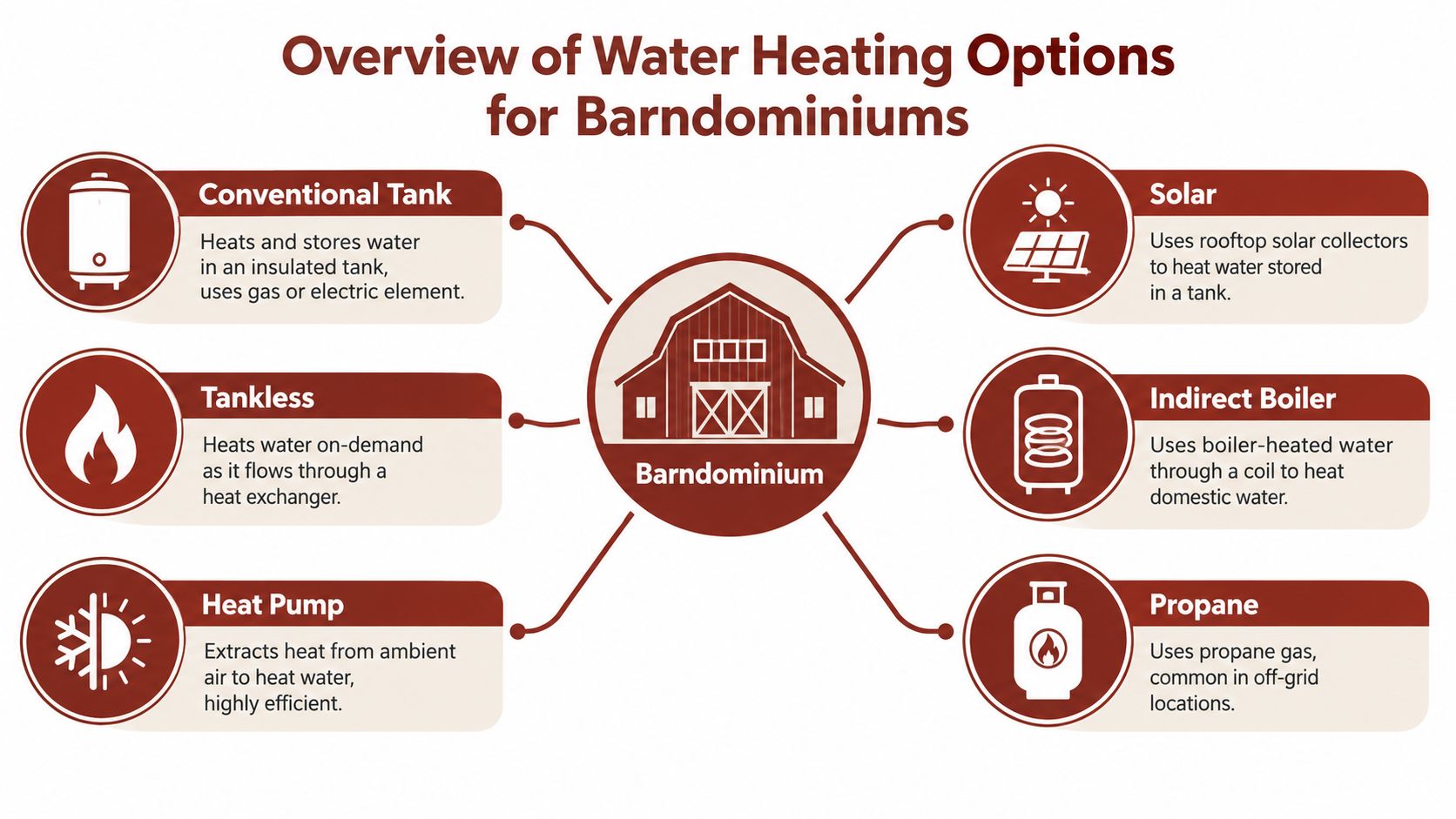
The six main water heating options differ in one basic way: some store hot water, while others heat it as you use it.
| Technology | How it heats water | Storage model | Typical barndominium fit |
|---|---|---|---|
| Conventional tank | Gas burner or electric resistance element heats stored water | Tank storage | Straightforward replacements and budget-conscious builds |
| Tankless | Gas burner or electric elements heat water through a heat exchanger | On demand | Compact layouts and properly sized high-demand systems |
| Heat pump | Pulls heat from surrounding air and transfers it into water | Tank storage | Efficient all-electric homes with suitable mechanical space |
| Solar thermal | Rooftop collectors heat water or a heat-transfer fluid | Tank storage | Solar-oriented homes with backup heating |
| Indirect boiler | Boiler fluid transfers heat through a coil | Tank storage | Homes already using a compatible hydronic boiler |
| Propane | Propane burner heats stored water or water moving through a heat exchanger | Tank or on demand | Rural properties without natural gas service |
UEF, or Uniform Energy Factor, measures how efficiently a water heater delivers hot water under standardized test conditions. A higher UEF generally means more hot-water output for each unit of energy consumed. Older literature may use energy factor, which is a related but different rating method. Don't compare the two casually as if they were identical.
A conventional electric tank uses resistance elements and keeps stored water hot. It's easy to understand and often easy to replace, but it has standby losses because the tank reheats water even when no fixture is running. Gas and propane tanks use combustion and need appropriate venting, clearances, and fuel infrastructure.
Tankless systems remove the storage tank and heat water as flow passes through the unit. That saves floor space and can provide continuous hot water when the gas line, electrical supply, flow rate, and unit capacity all match the household demand. A tankless installation isn't automatically simpler. The compact appliance may require a larger fuel line, dedicated electrical circuits, intake and exhaust planning, or multiple units for high simultaneous demand.
Heat pump water heaters still store hot water, but they use ambient heat rather than relying primarily on resistance elements. Solar thermal and indirect boiler systems also depend on storage, though their heat sources differ. In a barndominium, the first elimination test is practical: remove any system that doesn't match your available fuel, service capacity, placement, or maintenance capability.
Efficiency and Operating Cost Compared Head to Head
The efficiency gap is decisive for all-electric construction. ENERGY STAR-certified heat pump water heaters commonly show UEF ratings from 3.3 to 4.1, while standard electric resistance tanks generally fall around 0.90 to 0.95, according to ENERGY STAR's explanation of Uniform Energy Factor. Under DOE test conditions, that means a heat pump unit can deliver roughly three to four times the hot-water energy output per unit of input compared with resistance equipment.
| Technology | Typical UEF range | Relative efficiency vs electric resistance |
|---|---|---|
| Heat pump water heater | 3.3 to 4.1 | Roughly 3 to 4 times higher under DOE test conditions |
| Electric resistance tank | 0.90 to 0.95 | Baseline |
| Atmospheric gas storage | 0.58 to 0.65 | Lower than electric resistance on UEF, though fuel economics differ |
| Power-vented gas storage | 0.62 to 0.68 | Better than atmospheric gas storage |
| Condensing gas | 0.80 to 0.96 | Much better than conventional gas storage, often below the best heat pump units |
A DOE measure guideline reports that older electric resistance units typically operate around an energy factor of 0.9, while new heat pump models can exceed 2.0. In a 50-gallon comparison, a heat pump model rated at 2.35 saved 2,684 kWh per year against a resistance model rated at 0.90, as documented in the DOE building technologies guideline. The result is clear: if your barndominium has adequate electrical capacity and a suitable location, heat pump technology deserves the first look.
The efficiency verdict: For an all-electric, grid-connected barndominium, start with a heat pump water heater. Choose resistance only when installation simplicity, cold placement, or budget constraints outweigh long-term energy performance.
Gas technology has a wider range. Atmospheric storage units commonly fall between 0.58 and 0.65 UEF, power-vented models around 0.62 to 0.68, and condensing gas units around 0.80 to 0.96, based on the gas water-heater efficiency comparison. Condensing gas can substantially improve on a conventional vented tank, but it still generally trails the highest-efficiency heat pump systems.
DOE also states that heat pump water heaters can be two to three times more energy efficient than conventional electric resistance heaters, and that newer models can reduce electricity use for water heating by 50% or more. Its 2024 standards action estimated that replacing common-sized traditional electric storage heaters with heat pump models could save consumers about $1,800 in utility bills over the appliance lifetime. Those figures don't predict your exact bill. Electricity rates, water use, climate, settings, and installation conditions all matter.
For a propane-dependent property, the cheapest operating cost may not come from the highest UEF. Fuel delivery, tank ownership, standby losses, venting work, and service access can change the total. Use the barndominium cost planning guide to keep the water heater inside the larger mechanical and utility budget, rather than judging the appliance quote alone.
Sizing Installation and Infrastructure Requirements
A water heater can be efficient and still fail the build if it can't meet peak demand or fit the mechanical room. Sizing starts with first-hour rating for storage systems and flow rate for tankless systems. First-hour rating asks how much hot water the unit can deliver during a peak hour, including stored capacity and recovery. Flow rate asks whether the heater can serve simultaneous fixtures, such as two showers, a washing machine, and a kitchen faucet.
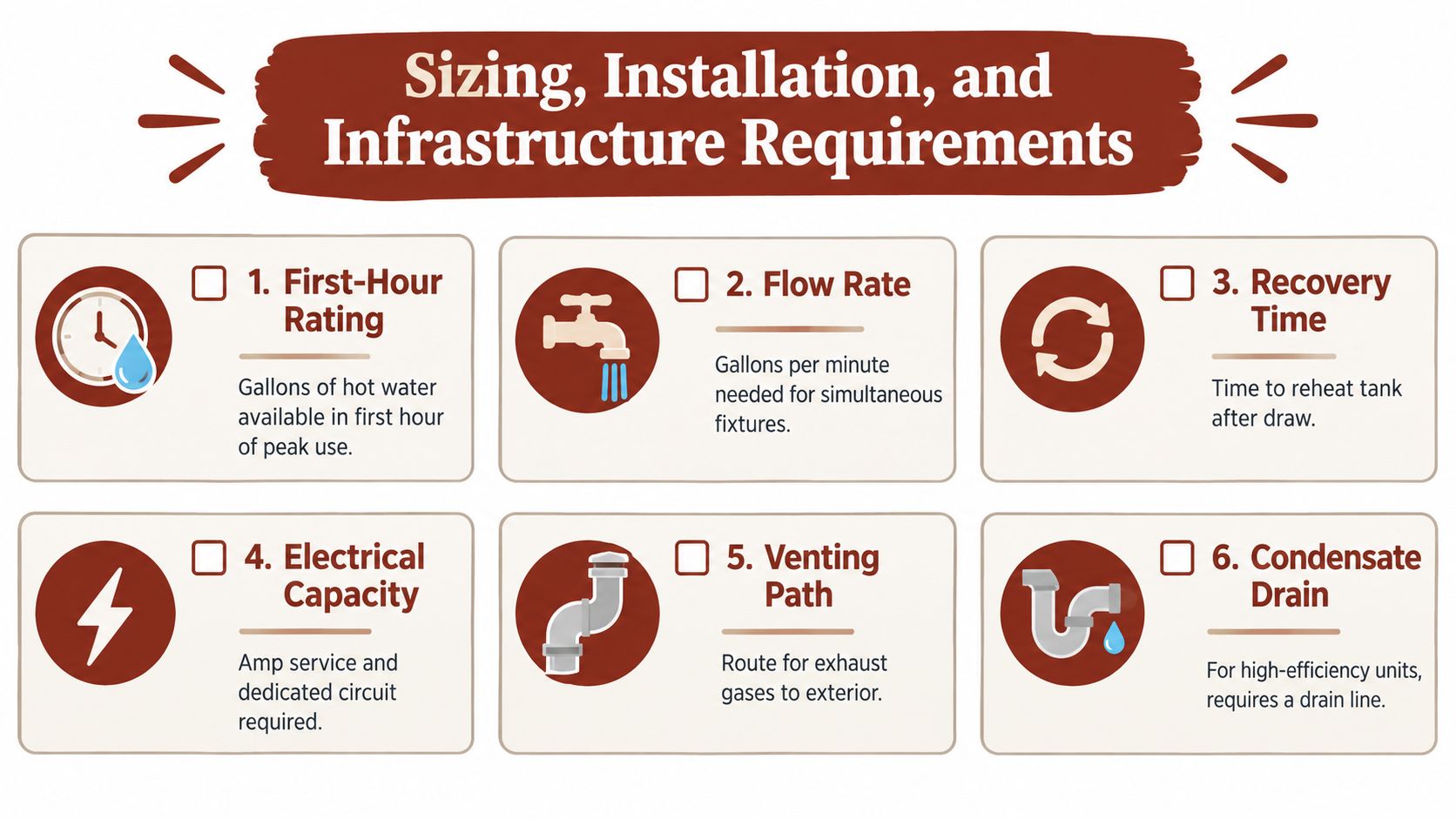
Match demand to recovery
A large household doesn't always need a tankless heater. A properly sized heat pump hybrid with storage can handle demand through stored hot water and scheduled recovery, while a tankless system must meet the combined flow and temperature rise at the exact moment fixtures run. A long barndominium may also need recirculation, better pipe routing, or a secondary point-of-use heater to avoid wasting water while waiting for distant fixtures.
For a shop-house layout, calculate the house and shop separately. A bathroom near the workshop may be better served by a compact point-of-use system than by extending a long hot-water line from the main mechanical room.
Audit the infrastructure before ordering
- Electrical capacity: Confirm service size, breaker space, voltage, conductor requirements, and whether the appliance shares a load-management plan with HVAC or vehicle charging.
- Venting path: Combustion systems need a code-compliant route for exhaust gases and appropriate combustion air. A clean vent route is easier to create before the shell and interior finishes are complete.
- Condensate drainage: High-efficiency combustion units and heat pump systems may produce condensate. Plan a drain, pump, freeze protection, and service access rather than leaving a pan as an afterthought.
- Ambient temperature: Heat pump performance depends on the air around the unit. A cold shop or garage can reduce heat pump operation and may trigger resistance backup, while a conditioned utility room may improve consistency.
- Clearance and airflow: Heat pump equipment needs room for air movement and service. Don't squeeze it between a wall, water softener, shelving, and a furnace.
- Pipe distance: Place the heater near major demand when possible. In long barndominiums, distributed systems may provide better comfort than one oversized central unit.
The retrofit market is responding to these constraints with flexible-voltage heat pump water heaters, split systems, and compact point-of-use designs. A 2026 DOE market report describes installation flexibility and form factor as important adoption factors, not secondary details. That matters for rural retrofits and owner-builders working with an existing panel or a narrow utility space.
Before approving a model, give the builder and trades a written constraint list. The questions to ask a barndominium builder should include who supplies the water heater, who sizes the circuits and fuel lines, who installs the vent and drain, and who verifies first-hour or flow performance.
Best Water Heating Options by Barndominium Use Case
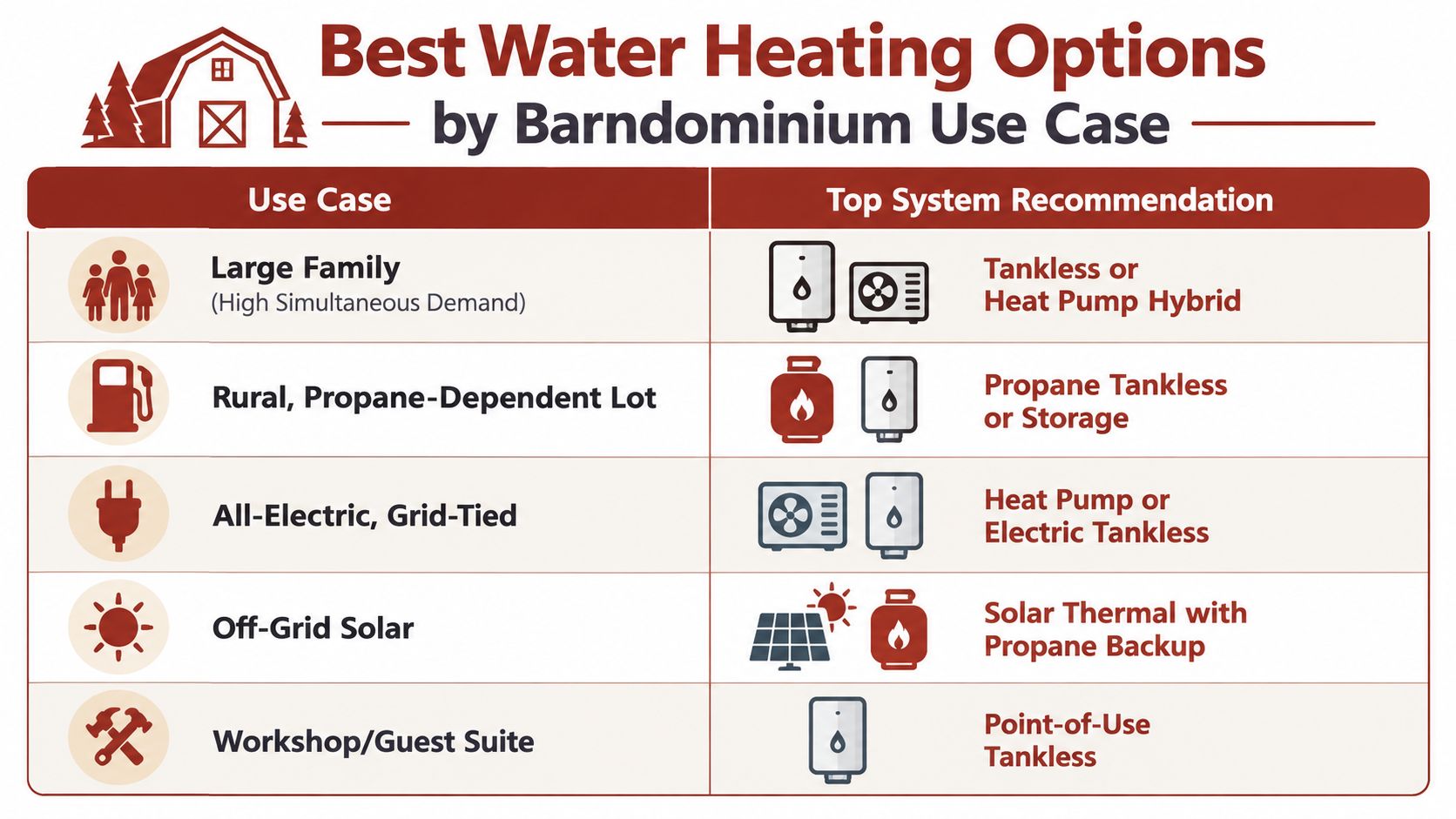
Technology matters, but the building's actual use usually makes the decision obvious.
Large family with simultaneous demand
Choose a properly sized tankless system or a heat pump hybrid. Tankless is attractive when continuous delivery and compact placement matter, but confirm flow under the home's incoming water temperature and required temperature rise. A heat pump hybrid is often the better all-electric choice because storage cushions overlapping showers and appliance use.
Decisive factor: Size for the busiest hour, not the average day.
Rural lot with propane service
Choose propane tankless or propane storage when propane delivery is already part of the property plan and electrical capacity is limited. Tankless saves space and avoids a large stored volume, but it needs accurate flow sizing and a properly designed propane supply. Storage is less demanding and often easier for a builder to install and service.
Don't choose propane solely because the property is rural. If propane tanks, trenching, regulators, venting, and future deliveries complicate the site, an electric heat pump may still be the cleaner long-term system.
All-electric, grid-tied build
Choose a heat pump water heater unless the installation location is unsuitable or the service cannot support it without unacceptable work. DOE guidance makes the efficiency case strong, and hybrid controls can preserve hot-water availability when demand rises. A basic electric resistance tank remains a reasonable fallback for a tight budget, difficult ambient conditions, or a simple replacement.
Off-grid solar home
Choose solar thermal storage with propane backup when the system can be designed, protected, and maintained properly. Solar thermal can reduce reliance on electric generation for water heating, but it needs roof collectors, piping, controls, storage, freeze protection where applicable, and a backup source for low-sun periods. A propane backup can provide resilience without sizing the off-grid electrical system around electric resistance heating.
Workshop and guest suite
Choose point-of-use tankless equipment for a remote bathroom or small guest area when running a long hot-water line would create excessive wait time and pipe waste. Confirm that the local electrical or propane supply can support the unit. This approach can also let the main house use a different technology without forcing every fixture into one centralized design.
The best solution may be a combination. A central heat pump water heater for the main home, a small point-of-use unit for a distant shop bathroom, and smart scheduling can outperform an oversized single appliance in a long, irregular floor plan.
Installation Maintenance and Long Term Resilience
Lock the water-heating decision into the construction schedule before insulation, drywall, and finished ceilings hide the routes. The plumber needs the final fixture plan. The electrician needs the appliance voltage and circuit requirements. The builder needs the vent, drain, access, and service clearances shown on the mechanical layout.
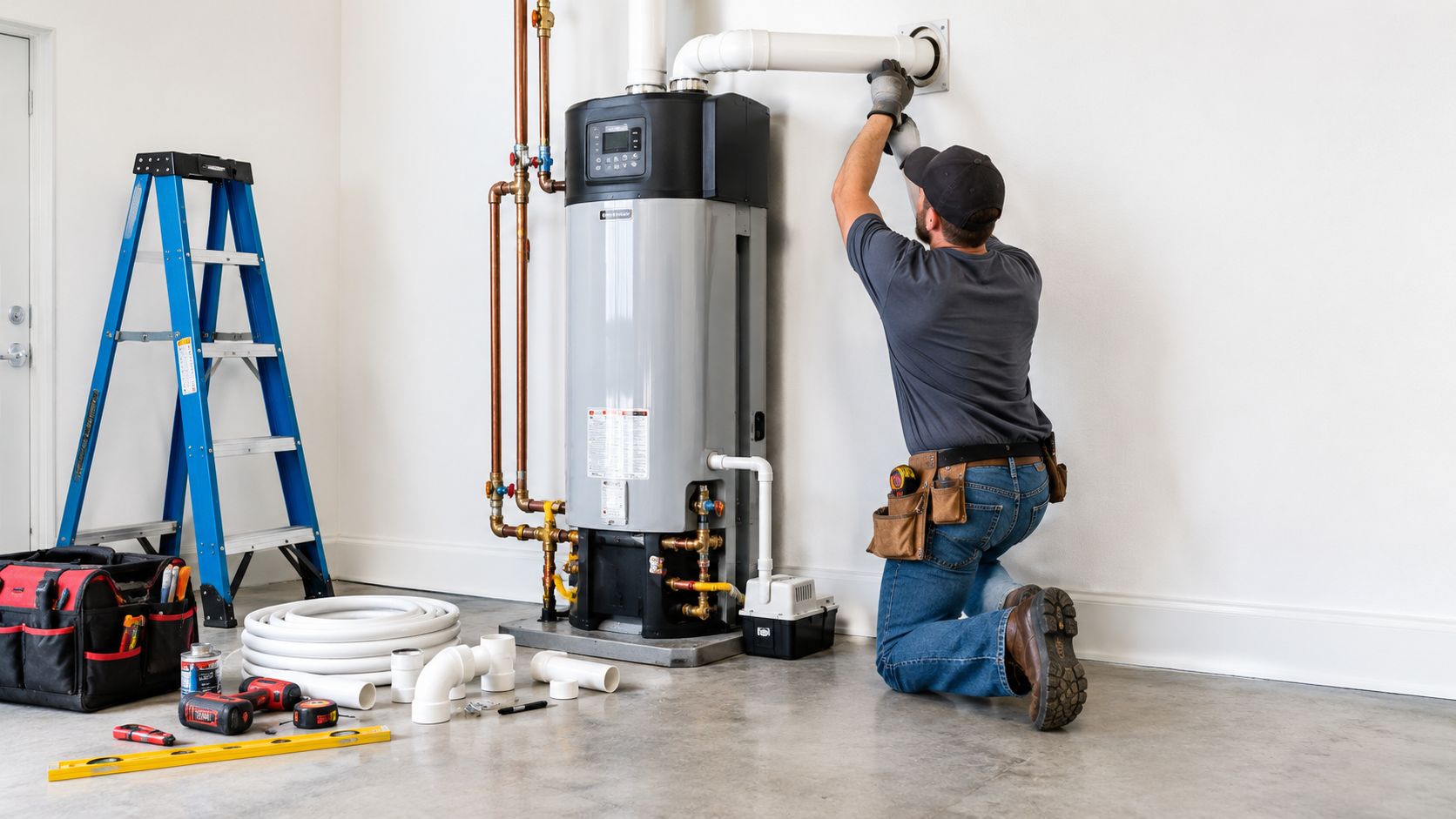
Build service access into the room
Leave a clear path to filters, controls, shutoff valves, anodes, mixing valves, and electrical disconnects. Route condensate to a visible, serviceable drain. Combustion equipment needs an inspected vent and safe termination. Heat pump equipment needs airflow, and a filter that can't be reached won't receive regular cleaning.
Hard water changes the maintenance plan. Tankless units need periodic descaling when mineral buildup threatens heat-exchanger performance. Storage tanks need attention to the anode rod and sediment conditions. Solar thermal systems need loop inspection, fluid checks where applicable, pump and control verification, and protection against local weather conditions. Propane systems need fuel-line, regulator, burner, and venting inspections by qualified technicians.
Smart and hybrid controls can improve resilience when used deliberately. Remote alerts may reveal a leak or fault before it damages a finished mechanical room. Load shifting can move heating into favorable utility periods or coordinate with solar production. Hybrid operation can reserve resistance or combustion backup for high-demand periods rather than using it continuously.
Policy and product changes also matter. Recent market coverage points toward connected hybrid systems, split units, flexible-voltage models, thermal storage, and controls designed for load shifting, while efficiency rules continue to influence the economics of gas, electric, and instantaneous equipment. A water heater market outlook describes this movement toward efficient and connected systems, but market forecasts are projections, not guarantees.
After installation, verify the result instead of accepting a powered-on appliance as proof of success. Test simultaneous fixtures, confirm hot-water delivery at distant bathrooms, inspect condensate flow, check combustion venting, confirm breaker and disconnect labeling, and document model numbers, settings, warranties, and maintenance intervals.
How to Choose the Right Water Heating Option and Next Steps
Use this decision path:
- If natural gas or propane is unavailable, start with a heat pump water heater or electric resistance tank. Favor heat pump technology when the electrical service and ambient space support it.
- If propane is already planned and electrical capacity is constrained, compare propane storage with propane tankless. Choose storage for installation simplicity and tankless for compact placement or continuous demand.
- If the home is all-electric and grid-tied, make the heat pump water heater the default option. Reject it only after checking ambient temperature, airflow, drainage, service access, and panel capacity.
- If the building is long or includes a remote shop bathroom, consider point-of-use equipment or a carefully designed recirculation system instead of blindly oversizing the central heater.
- If the property is off-grid, design solar thermal or another storage-first system with dependable backup. Don't force an energy-intensive electric solution onto a small generation system without a complete load plan.
- If the mechanical room is tight, prioritize form factor early. Split, flexible-voltage, and compact models may solve a fit problem that efficiency ratings alone can't address.
Request quotes that identify the exact model, UEF or efficiency rating, first-hour rating or flow capacity, voltage, breaker requirements, fuel-line size, vent materials, condensate plan, clearances, and warranty. Ask the builder who owns each part of the installation. Many disputes begin when the appliance is included but the electrical upgrade, venting, drain, or startup commissioning isn't.
Your best water heating option is the one that meets peak demand, fits the room, matches the available energy infrastructure, and remains serviceable as rules and utility conditions change. For most all-electric barndominiums, that's a heat pump water heater. For propane-ready rural builds, propane storage or tankless can be the cleaner answer. For remote fixtures and off-grid homes, distributed or solar-backed designs deserve serious consideration.
Use BarndoBuilderList to research barndominium-friendly builders, compare state and ZIP-based shortlists, and identify candidates before requesting water-heating and mechanical-scope quotes. Bring your preferred system, placement constraints, and infrastructure checklist to those conversations so the builder prices a complete installation rather than just an appliance.
- water heating options
- barndominium water heater
- heat pump water heater
- tankless vs tank
- water heater sizing