Barndominium Warranty Claim Process: Your Step-by-Step Guide
Master the warranty claim process for your barndominium. Learn evidence gathering, escalation steps, templates, and state-specific advice for builder disputes.
A successful warranty claim depends on a controlled evidence trail and written notice, not a casual phone call. The Magnuson–Moss Warranty Act was enacted in 1975, and covered goods manufactured on or after July 4, 1975 fall within its framework.
You're standing in the unfinished living room when you notice water staining around a window. The shell contractor says the window manufacturer should handle it. The manufacturer says the unit was installed incorrectly. Your general contractor asks for photos, but nobody can find the change order showing who supplied the window or the inspection note recording when the leak first appeared.
That kind of handoff is common in barndominium construction. A single home may involve a metal-building manufacturer, shell contractor, general contractor, window supplier, roofer, electrician, and owner-supplied materials. The warranty claim process becomes difficult when everyone has a different version of what happened.
The practical answer is to treat the claim as a documented project, not an informal request for help. Identify the responsible party, preserve the condition, verify the applicable warranty, submit written notice through the required channel, and track every response. The objective isn't to sound aggressive. It's to make the facts clear enough that a builder, manufacturer, inspector, mediator, or court can understand the dispute without relying on memory.
Table of Contents
- Understanding Your Barndominium Warranty Rights
- Preparing Your Evidence and Documentation
- Filing Your Warranty Claim Letter
- Tracking Claim Performance and Avoiding Pitfalls
- Escalating When Builders Are Nonresponsive
- Handling Manufacturer Component Claims
Understanding Your Barndominium Warranty Rights
The first question is not, “Who should I call?” It's, “What promise covers this problem?” A roof leak, for example, might involve a builder's workmanship warranty, a roofing-material warranty, an installation warranty, or several of these at once. Each document can define coverage, exclusions, notice requirements, repair authority, and the party responsible for service.
The Magnuson–Moss Warranty Act created the principal federal framework for consumer-product warranty claims in the United States. It applies when a supplier provides a written warranty or enters into a qualifying service contract, but it doesn't require a manufacturer or seller to offer a warranty. Once a covered written warranty exists, however, the promises must be disclosed clearly, and the warrantor, supplier, or service contractor may have obligations when it fails to perform them. The Act also addresses “full” and “limited” warranties, restricts deceptive language, and generally prevents a business from conditioning warranty coverage on the use of a particular branded replacement part or service. The legal background on Magnuson–Moss and warranty obligations provides useful context.
Separate the promise from the assumption
A builder may tell you, “We'll take care of it,” during a walkthrough. That statement may be useful evidence, but it isn't a substitute for reading the signed warranty, contract, plans, and exclusions. Look for provisions covering:
- Workmanship: Installation quality, framing, flashing, trim, finishes, and correction of construction defects.
- Materials: Product-specific promises from the roof, window, siding, door, or metal-building manufacturer.
- Duration and notice: The coverage period, required notice method, inspection rights, and deadlines.
- Exclusions: Maintenance, owner-supplied work, weather damage, normal settlement, misuse, alterations, or failure to follow care instructions.
- Remedies: Repair, replacement, refund, inspection, or another stated remedy.
A barndominium's construction history makes this review especially important. Before hiring a builder, ask detailed questions about post-build service, responsibility for subcontractors, and the route for warranty issues. The questions to ask a barndominium builder can help you identify these responsibilities before a dispute arises.
Build a defensible workflow
A defensible claim moves through coverage review, notice, diagnosis, attempted repair, and resolution or escalation. That sequence protects you from two opposing mistakes: making repairs before the responsible party can inspect the condition, or waiting so long that additional damage occurs.
Your rights aren't strongest because you sound frustrated. They're strongest when the contract, photographs, dates, communications, and technical findings support the same explanation. Keep the original warranty document, proof of purchase, service records, and communications together from the first sign of trouble.
Preparing Your Evidence and Documentation
Before calling the builder, create a claim folder and a defect log. The folder can be digital, paper, or both, but it needs one consistent naming system so you can locate the relevant document quickly. A vague complaint such as “the back room has moisture” gives the other party room to argue about location, cause, and timing.

Start with the condition itself
Record the exact room, wall, elevation, component, and nearby reference point. For example, “staining on the interior drywall below the north window in the guest bedroom” is more useful than “leak in the bedroom.” Add the observed symptoms, discovery date, weather conditions if relevant, and whether the problem is active, intermittent, or unchanged.
Take wide photographs that establish context, medium photographs showing the affected assembly, and close photographs of the symptom. Capture video when the issue moves, sounds, drips, or appears only during operation. Keep the original files, because editing, cropping, or sending compressed images can remove useful metadata.
Test the coverage question
Read the warranty provisions before you decide how to describe the defect. Ask yourself whether the condition could instead be:
- Normal settlement: Minor movement or finish changes that the contract may treat differently from a construction defect.
- Weather damage: Wind, hail, flooding, ice, or another event that may fall outside workmanship coverage.
- Maintenance: Blocked drainage, failed caulking maintenance, neglected filters, or another owner responsibility.
- Owner-supplied work: A component or installation performed outside the builder's contracted scope.
- Workmanship or material failure: An installation error, defective component, or failure to follow the plans.
Don't guess at the technical cause if you don't know it. Describe what you can observe, then request an inspection and written coverage determination.
Assemble the project record
Your claim packet should include:
- Contract documents: The purchase or construction contract, warranty provisions, and any service agreement.
- Scope evidence: Plans, specifications, selections, change orders, and documents identifying who supplied and installed the component.
- Condition records: Inspection reports, punch lists, photographs, video, measurements, and the chronological defect log.
- Financial records: Invoices, receipts, proof of purchase, maintenance records, and expenses connected to temporary protection or diagnosis.
- Communication history: Emails, text messages, letters, call notes, names, claim numbers, and promised response dates.
The post-build support history of a prospective builder can matter before construction begins. Resources that identify builders with warranty, service-call, repair, or punch-list references, such as builders tagged for warranty and post-build support, can help you ask sharper questions during selection.
Write the defect log in chronological order. Each entry should state the date, event, person contacted, response, document created, and next action. Keep opinions separate from observations. “Water appeared on the sill after rain” is evidence. “The flashing is definitely defective” is a conclusion that may require an inspection.
Practical rule: Preserve the condition long enough for the responsible party to inspect it, unless immediate action is needed to prevent injury or serious property damage.
Filing Your Warranty Claim Letter
A phone call can alert a builder, but written notice creates a record of what you reported and when you reported it. Start with the contract's notice provision. It may identify a mailing address, email address, warranty administrator, online portal, or required form. Send the claim through that channel, then preserve proof of submission.
The FTC's consumer warranty guidance recommends contacting the seller first and writing to the manufacturer if the seller doesn't resolve the issue. It also identifies certified mail with a return receipt as a way to show that written notice was received. For a barndominium, follow the contract even if another delivery method seems faster.
Put the necessary facts in one letter
Use a clear subject line with the property address and project or claim identifier. The body should identify:
- The parties: Your name, property address, builder, shell contractor, manufacturer, and any relevant subcontractor.
- The component: Product name, model, serial number, lot information, or project identifier when available.
- The defect: Exact location, symptoms, discovery date, and whether the condition is continuing.
- The coverage basis: The warranty or contract provision you believe applies.
- The requested remedy: Inspection, repair, replacement, diagnosis, or a written coverage decision.
- The attachments: A numbered list of photographs, reports, invoices, and other supporting records.
- The response request: A reasonable written response date, consistent with the contract and the circumstances.
A concise claim can read like this:
Subject: Warranty claim for water intrusion at [property address]
I'm providing written notice of water intrusion at the north bedroom window, first observed on [date]. The attached photographs show staining below the interior sill and exterior conditions at the window head. Please inspect the condition and provide a written coverage determination identifying the applicable warranty provision. I request confirmation of receipt, the inspection process, and the proposed remedy.
Avoid accusing the builder of fraud, negligence, or bad faith unless a qualified professional has advised you to make that allegation. A factual letter is harder to dismiss as emotional, and it leaves room for a technical resolution.
Control the communication record
After every call, write down the date, time, person, telephone number, claim number, substance of the conversation, promised action, and deadline. Follow up with a short email confirming your understanding. If the other party refuses to communicate in writing, your contemporaneous note still creates a useful record.
Don't authorize third-party corrective work before notifying the warrantor when the condition can safely remain. Emergency stabilization may be necessary, but photograph the condition first, preserve removed materials when practical, retain invoices, and notify the responsible party as soon as possible.
Tracking Claim Performance and Avoiding Pitfalls
Builders and warranty administrators often measure service performance with operational metrics. You can use the same idea as a homeowner, not to manufacture a complicated dashboard, but to determine whether your claim is moving toward a verified repair.
The most useful measure is first-time-fix rate, or FTFR. It means the share of claims fully resolved during the first repair attempt or service visit, calculated as claims resolved on the first attempt divided by claims requiring service, multiplied by one hundred. A published warranty-operations benchmark places average FTFR around 70% to 75%, while high-performing organizations are placed around 85% to 95%. The warranty KPI benchmark and FTFR definition explain why better triage improves the chance that a technician arrives with the right parts, tools, and authority.
You don't need to demand that a small builder meet a commercial benchmark. You can, however, ask whether the first visit is an inspection, a temporary repair, or a complete correction. Those are different outcomes, and closing a ticket after someone merely visits the property hides the difference.
Track the claim in a simple table
| Metric | Definition | Why It Matters |
|---|---|---|
| Days to first response | Time from written notice to acknowledgment or substantive reply | Shows whether the claim entered an active workflow |
| Days to inspection | Time from notice to an on-site or documented technical review | Separates acknowledgment from actual investigation |
| Repeat-visit rate | How often the same defect requires another service visit | Reveals incomplete diagnosis, missing parts, or unclear authority |
| Aging by claim status | How long the claim remains awaiting review, inspection, repair, or closure | Shows where the process is stalled |
| Denial rate by reason | Denials grouped by exclusion or stated factual basis | Helps identify whether the decision is consistent and supported |
| Reopen rate | Claims reopened after being marked complete | Shows whether closure reflects a lasting repair |
| Cost per resolved claim | Documented cost associated with completing the repair | Helps organize out-of-pocket expenses and competing remedies |
Don't accept administrative closure as completion
A claim isn't complete because a technician was dispatched. For residential construction, closure should include a written repair scope, before-and-after evidence, homeowner acceptance or a recorded objection, and follow-up where the problem could recur.
Common process failures include combining several unrelated defects into one vague work order, treating unresolved workmanship as homeowner maintenance without a written technical rationale, and authorizing repairs without preserving evidence. Keep separate claim numbers or sections for a leaking window, cracked slab finish, electrical issue, and roof problem. Different components may have different responsible parties and different coverage terms.
A repaired symptom isn't necessarily a corrected cause. Ask what was repaired, why that repair should solve the problem, and what evidence confirms completion.
Escalating When Builders Are Nonresponsive
A barndominium warranty dispute can stall after the builder receives photos, invoices, and repeated follow-ups. Treat the silence as a documented process failure, not as an informal conversation. A denial and a delay require different responses. A denial is a stated decision based on an exclusion, lack of coverage, alleged owner responsibility, or another reason. An unreasonable delay means the builder has not provided a practical response or remedy after receiving adequate notice.
For a denial, request the exact contract or warranty clause, the facts relied upon, and the evidence the reviewer says is missing. For a delay, request the current status, the next action, the person responsible, and a written date for completion. Keep the shell contractor, general contractor, and any warranty administrator identified separately so responsibility does not disappear between companies.
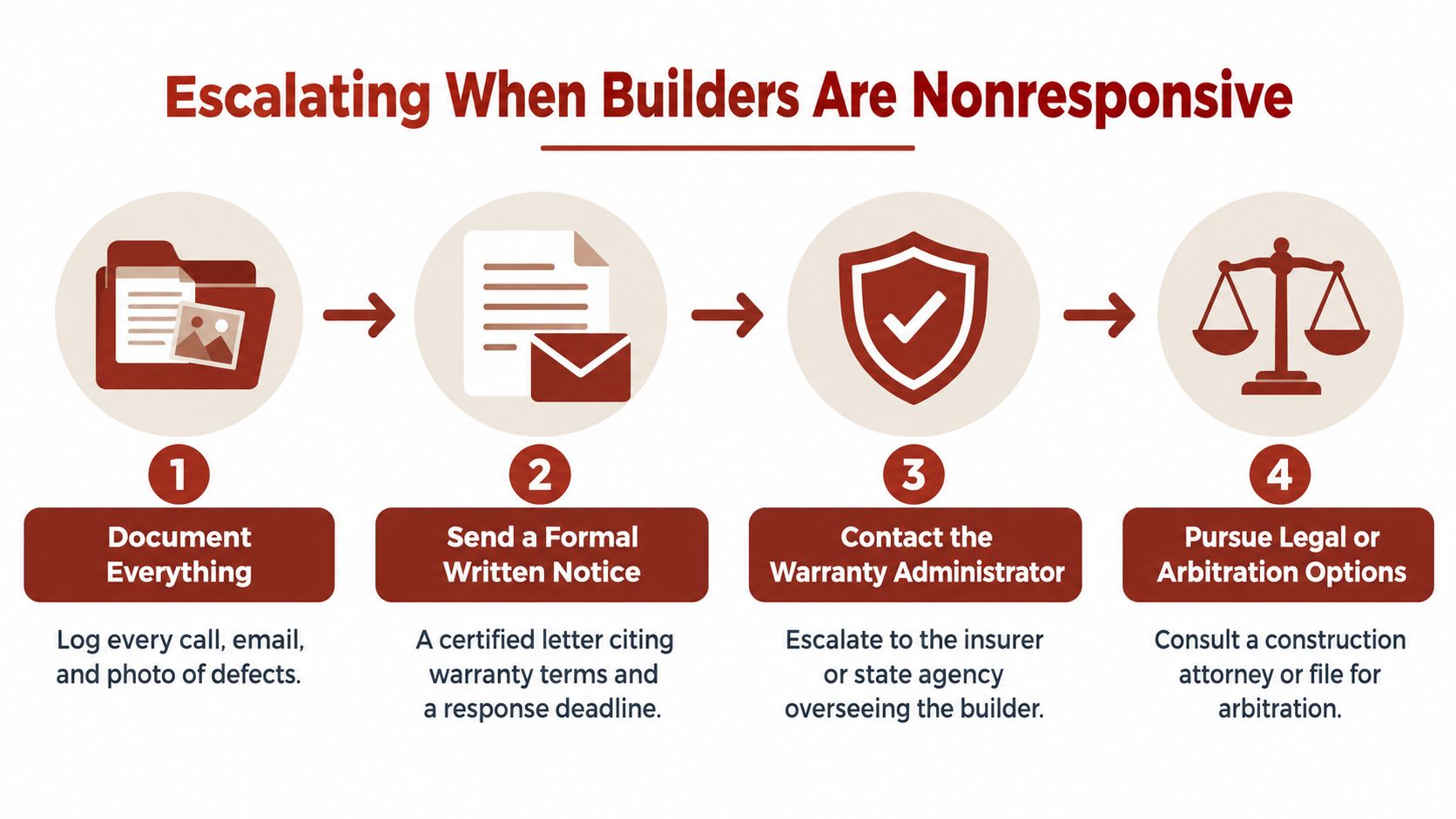
Use a staged escalation
Start with a correction or status request. Restate the defect, the original notice date, the documents supplied, and the question that remains unanswered. If the builder calls the problem excluded, request the specific exclusion and a technical explanation connecting that language to the observed condition.
Send formal written notice next. Use the address or channel required by the contract. Certified mail with a return receipt can help prove delivery when the dispute is becoming serious. Set a response deadline that fits the defect and follows the contract's procedure. Avoid threatening a lawsuit or other consequence unless you are prepared to take that step.
Identify the responsible administrator. The builder may handle workmanship, while a third-party warranty company handles another claim. A metal building manufacturer may control a component warranty, but that does not automatically resolve an installation or coordination defect. Send each party the existing evidence packet and state which issue remains unresolved.
Choose an outside remedy. Depending on the contract and location, options may include supervisor review, a complaint to a state regulator or attorney general, mediation, arbitration, small claims, or a construction attorney's review. Legal advice can clarify notice provisions, filing limits, expert evidence, and whether the dispute belongs against the builder, subcontractor, manufacturer, or several parties. If you would rather hand off the coordination, BarndoBuilderList's concierge service can help coordinate next steps with vetted builder contacts.
Measure the practical harm
Record temporary protection, inspections, travel, storage, emergency service, and other out-of-pocket expenses. Some costs may not be recoverable, but missing receipts weaken your position. Rural barndominium owners may also face long travel distances, limited authorized technicians, weather interruptions, and difficulty finding an inspector familiar with post-frame construction.
The EU consumer guarantee framework provides a comparative benchmark by separating coverage from practical delivery of a remedy. It describes repair or replacement as free and recognizes refund rights when the seller cannot complete the remedy within a reasonable time and without significant inconvenience. U.S. rights depend on the contract, applicable state law, and the facts. The immediate takeaway is useful: coverage does not answer who pays for diagnosis or how quickly the repair must be delivered.
For an unresolved U.S. complaint, FTC guidance supports documenting communications and expenses and considering escalation to the FTC or a state attorney general. Preserve the complete record before filing. A regulator may review a pattern or process concern, but it may not perform the technical inspection or award the remedy you seek.
Escalation principle: Give each stage a defined question, a documented deadline, and a named decision-maker. Stronger language alone does not move a claim.
Handling Manufacturer Component Claims
A barndominium warranty dispute often has two tracks. The builder track concerns installation, workmanship, coordination, and compliance with the plans. The manufacturer track concerns a component's own written warranty, such as a metal panel, window unit, roofing product, door, appliance, or equipment part.
Don't choose one track too early if the cause is uncertain. A window can fail because the glass unit is defective, the frame was damaged, the opening was out of square, the flashing was installed incorrectly, or several conditions contributed. Sending the owner from builder to manufacturer and back again creates delay unless both parties receive the same factual packet.
Identify responsibility by component
Create a component schedule with the product, supplier, installer, warranty document, project location, and claim contact. Match invoices and change orders to each item. The construction contract may show that the builder supplied a product, while a separate manufacturer warranty may require the owner to contact the manufacturer directly.
Ask each party to answer a specific question in writing:
- Is the reported condition within the stated coverage?
- Does the warranty require an authorized inspection?
- Is the alleged cause a product defect, installation issue, maintenance issue, or excluded event?
- What evidence is missing?
- Who is authorized to perform the repair?
- Will third-party work affect coverage?
A written coverage determination is more useful than a general statement that “the product isn't covered.” If the manufacturer denies the claim, request the clause and factual basis. If it says installation caused the failure, send that determination to the builder and ask for a workmanship review.
Protect the evidence while both tracks proceed
Obtain an independent inspection when the parties disagree about cause, but choose an inspector with relevant experience in metal-building assemblies, roofing, windows, moisture intrusion, or the specific component involved. Preserve the report, photographs, measurements, and removed materials. Don't authorize permanent corrective work solely because a manufacturer or builder has stopped responding, unless safety or further damage requires it.
Send identical core evidence to each responsible party, then keep separate correspondence folders. This prevents one party from claiming it never received the inspection report and makes conflicting explanations easier to compare.
A good resolution may require cooperation rather than a single admission. The manufacturer may replace a component while the builder corrects the flashing or opening. Recording those responsibilities in writing prevents a partial repair from being mistaken for a complete resolution.
The work starts before a dispute. Compare builders by scope, service procedures, and responsibility for subcontracted work, then save the promises that influenced your decision. When a claim appears, use the same discipline: identify the component, preserve the condition, send notice, request a written determination, and track completion.
BarndoBuilderList provides a research-driven directory of barndominium-friendly builders, with builder profiles, scope notes, warranty and post-build support signals, and questions that help buyers evaluate service responsibilities. Visit BarndoBuilderList to build a more informed shortlist before choosing the team that will construct and support your home.
- warranty claim process
- barndominium warranty
- builder disputes
- construction claims
- barndominium guide