Mediation and Arbitration for Barndominium Buyers
Understand mediation and arbitration before signing a barndominium contract. Compare costs, timelines, enforceability, and learn which clause protects you best.
You're three months past the shell-completion date. The steel frame is only partly enclosed, the builder keeps blaming a subcontractor, and your construction loan is still accruing interest while the property sits unfinished. You reread the contract and find a paragraph requiring “binding arbitration,” but nothing explaining what happens first, who pays, or where the proceeding will occur.
That clause matters before the first post is set. Mediation and arbitration aren't interchangeable, and choosing the wrong sequence can cost a rural landowner control, time, and influence. For most barndominium disputes, I recommend a carefully drafted mediation-first clause, followed by arbitration only if a negotiated resolution fails.
Table of Contents
- What Mediation and Arbitration Actually Mean for Your Build
- Comparing Costs Timelines and Control
- Why a Mediation-First Clause Outperforms Arbitration Alone
- Contract Clause Language You Should Negotiate
- Your Action Plan When a Dispute Arises
- When to Bring in an Attorney
- Key Questions to Ask Builders Before You Sign
What Mediation and Arbitration Actually Mean for Your Build
Suppose your builder promised to complete the shell by a stated date. The deadline passes, then another month passes, and the builder asks for more money before ordering the doors and roofing materials. You believe the delay violates the contract. The builder says weather, material availability, or your change requests excuse the delay.
That's a dispute, but it doesn't automatically require a courtroom or a private trial. Your contract may direct you into mediation, arbitration, or a sequence requiring both.
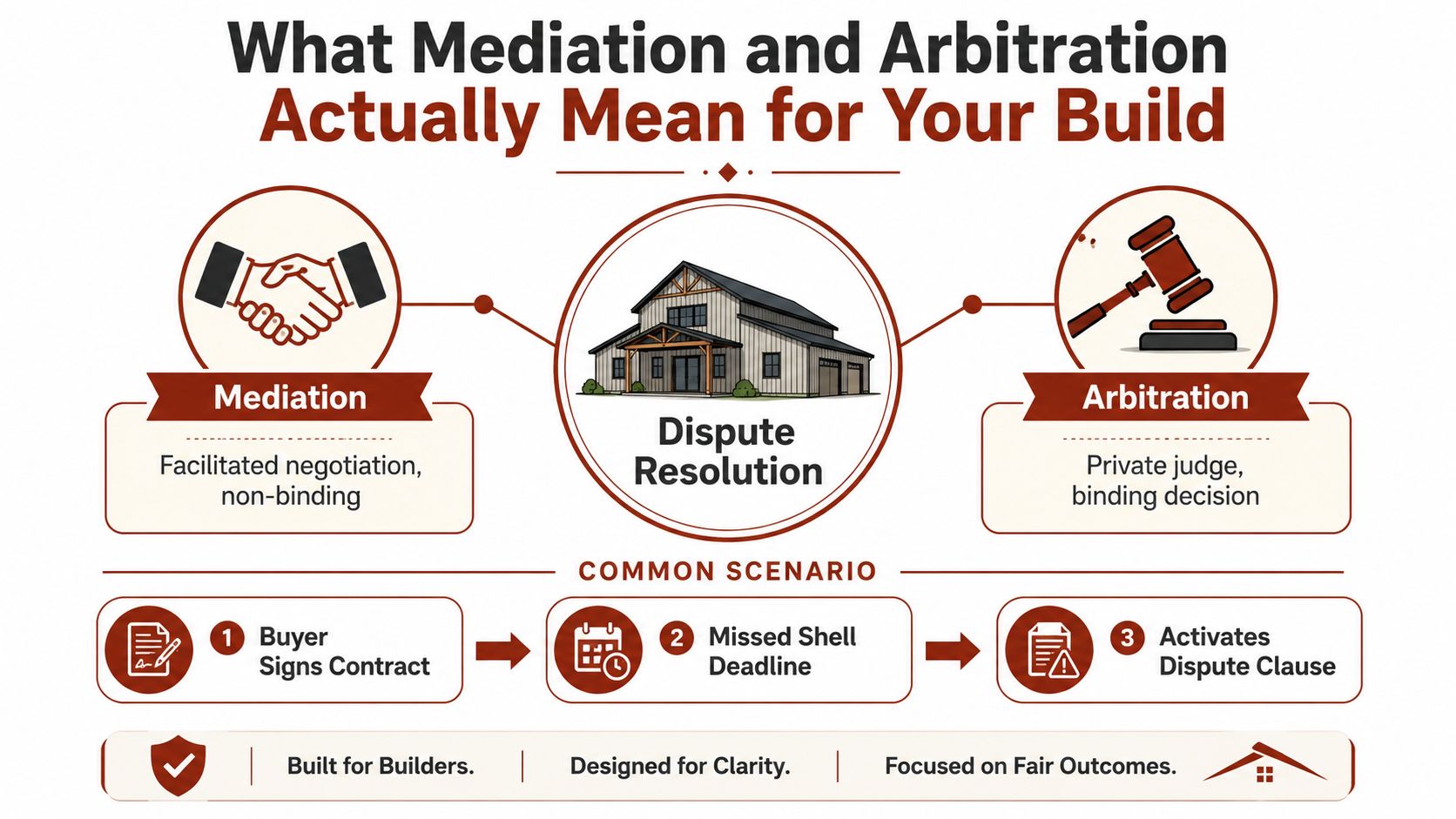
Mediation keeps the decision with you
Mediation is a structured negotiation assisted by a neutral mediator. The mediator doesn't act as a judge and usually can't force either side to accept a result. Instead, the mediator helps identify the key points of disagreement, tests weak positions, and explores settlement terms.
You and the builder keep control. You might agree to a revised completion schedule, a credit for documented delay costs, a punch-list procedure, or a partial release of disputed funds. You can also walk away without settling and preserve the right to pursue the next contractual step.
The mediator is typically selected by agreement or through an institution named in the contract. A construction-experienced mediator can understand the difference between a genuine structural problem and a cosmetic punch-list complaint. That knowledge matters when the dispute involves engineered plans, post-frame connections, insulation, concrete work, or responsibility divided among several trades.
Arbitration gives the decision to someone else
Arbitration is a private adjudicative proceeding. The arbitrator reviews evidence, hears arguments, and issues a decision, often called an award. Depending on the clause and applicable rules, the award may be binding, with only narrow opportunities to challenge it.
That structure can be useful when the builder refuses to negotiate or when you need a final decision on defective work, unpaid invoices, delay damages, or contract termination. But you surrender much of the flexibility you had in mediation. The arbitrator, not you, decides what relief is available under the contract and evidence.
Practical rule: Mediation preserves your ability to design a business solution. Arbitration preserves your ability to obtain a decision when the other side won't make a fair deal.
Before signing, read the entire dispute section, including incorporated institutional rules. Buyers comparing builders and contract scopes can also use the barndominium buyer guides to prepare questions before committing to a project.
Comparing Costs Timelines and Control
The common mistake is to compare only filing fees. The expense includes attorney time, document collection, expert review, travel, hearing preparation, and the cost of keeping a disputed project alive while the process runs.
Mediation generally has a narrower scope. The parties exchange enough information to negotiate intelligently, meet with a neutral, and decide whether settlement makes sense. Arbitration can require formal submissions, document production, witness preparation, expert testimony, and a hearing. A complicated construction arbitration can begin to resemble litigation, even though it occurs outside court.
The decision framework is straightforward:
| Factor | Mediation | Arbitration |
|---|---|---|
| Control | You and the builder decide whether to settle and on what terms. | The arbitrator decides the dispute. |
| Cost exposure | Usually limited to preparation, counsel if used, and the mediator's charge. | Includes preparation, counsel, arbitrator fees, administration, discovery, experts, and hearing expenses. |
| Speed | Can be arranged quickly if the clause and neutral-selection process are clear. | Timing depends on pleadings, evidence, scheduling, discovery, and hearing availability. |
| Finality | No settlement means the dispute can proceed to the next available forum. | A binding award may end the merits dispute, with limited review. |
| Relationship impact | Allows a workable construction solution without assigning a formal winner. | Produces a decision, but often hardens the parties' positions. |
| Enforcement | A signed settlement is generally enforced as an agreement, subject to its terms and governing law. | An award has a formal enforcement pathway, but collection still requires attention to assets and procedure. |
The supplied visual uses illustrative cost and timing ranges. Don't treat those figures as a promise for your dispute. Your contract, state law, institutional rules, project complexity, and attorney involvement will control the actual bill and schedule. For a broader project-budget discussion, review the guide to barndominium cost factors.
Arbitration does offer a meaningful cross-border enforcement advantage. The United Nations' arbitration materials report that enforcement was granted in almost 90% of more than 1,400 reported court decisions under the New York Convention, although enforcement still depends on drafting, the arbitral seat, and applicable Convention defenses. That makes a well-drafted arbitration agreement valuable when parties or assets sit in different jurisdictions, but it doesn't guarantee collection.
For a domestic barndominium build, the practical question is usually simpler: can you obtain a sensible construction remedy without paying to litigate every disputed invoice and delay?
Why a Mediation-First Clause Outperforms Arbitration Alone
Arbitration isn't automatically the fast option. Construction disputes often involve plans, change orders, inspection records, payment applications, text messages, delivery records, and competing opinions about defective work. Once the parties hire experts and contest discovery, arbitration can consume substantial time and money.
Mediation gives both sides a controlled opportunity to settle before those costs expand. Empirical reviews of court-connected and provider-based programs report settlement rates commonly in the 47% to 78% range, with many studies clustering around 50% to 85%. One review of 449 cases across four major ADR providers reported an overall 78% settlement rate, as summarized in the cited mediation research. Those findings don't predict your case, but they do show that mediation is a serious dispute-resolution mechanism, not a courtesy meeting.
The institutional evidence favors an early settlement attempt
FINRA's 2026 statistics, covering matters through June 2026, show an 82% mediation settlement rate and a median turnaround time of 98 days. FINRA's comparable 2025 through-June figures also showed an 82% settlement rate, with a 120-day turnaround time. FINRA handles securities disputes, not barndominium construction claims, so you shouldn't transplant the result mechanically. The data does support a broader point: a properly administered mediation program can resolve disputes before a full merits proceeding becomes necessary. See the FINRA dispute-resolution statistics for the underlying figures.
The ICC's institutional data also shows mediation operating in substantial international disputes. In 2024, its ADR Centre received 37 mediation requests involving 93 parties from 33 countries, and confirmed or appointed 21 mediators from multiple regions. In 2025, the ICC reported 36 mediation requests, reinforcing that mediation is being used as an institutional process rather than reserved for minor disagreements.
Draft the clause as a sequence, not a dead end
A buyer-friendly clause should require:
- Written notice of the dispute, identifying the contract provisions, facts, and requested cure.
- A short senior-management meeting, if the parties can conduct it without delaying urgent relief.
- Mediation with a neutral selected by both parties or appointed by a named neutral organization.
- A defined mediation window, with an express right to proceed if the builder refuses to participate or negotiations fail.
- Arbitration as the next step, under identified rules, before an identified institution or neutral appointing authority.
This sequence protects you from rushing into arbitration while preventing the builder from using mediation as an endless delay tactic. The clause should also preserve court access for emergency measures, lien issues, property protection, and claims that cannot be effectively resolved through the agreed process.
The strongest version doesn't say mediation will solve every dispute. It says both sides must make a genuine, time-limited attempt before paying for a private trial.
Contract Clause Language You Should Negotiate
Start with the dispute clause, not the builder's sales promises. A polished proposal can describe cooperation and quality control, but the dispute paragraph determines what happens after the relationship breaks down.
Ask for language that identifies the trigger, the notice method, the neutral-selection process, the governing rules, the location, and the transition from mediation to arbitration. A usable clause might read:
“Before commencing arbitration, either party shall provide written notice describing the dispute and requested relief. The parties shall participate in mediation with a mutually agreed construction mediator. If they cannot agree on a mediator, the mediator shall be appointed by the neutral organization identified in this agreement. Mediation shall begin within a reasonable period after notice and shall conclude when the mediator declares an impasse or the stated mediation period expires. Either party may then commence arbitration under the identified institutional rules.”
Have a lawyer adapt that language to your state and project. The phrase “reasonable period” may need a specific contractual deadline, and the agreement should address whether remote attendance is permitted, how fees are divided, and what happens if one party refuses to pay.
Red flags that deserve a pause
- Builder-controlled selection: The builder alone chooses the mediator or arbitrator. That creates an avoidable neutrality concern.
- Unidentified rules: The clause says “arbitration under applicable rules” without naming the institution or procedure.
- Remote venue for the buyer: You must travel to the builder's home county even though the land and project are elsewhere.
- No emergency carve-out: The clause blocks court relief for mechanic's liens, threatened property damage, evidence preservation, or urgent possession issues.
- One-sided fee shifting: You pay all fees regardless of who caused the dispute or who prevails.
- No notice procedure: The builder can later argue that your emails didn't satisfy a contractual claim notice.
You should also ask how the contract treats unpaid amounts during a dispute. A clause that permits the builder to stop all work immediately, charge broad suspension fees, or file a lien while you pursue mediation can leave you with little bargaining power.
Use a focused list of questions for your barndominium builder before accepting the contract. If the builder refuses every neutral protection, don't rationalize that response. A builder's reaction to reasonable dispute language tells you something about how the builder expects to handle conflict.
Your Action Plan When a Dispute Arises
Do not wait for the project to become obviously unfixable. The first missed milestone, unexplained change order, or departure from the engineered plans may trigger notice requirements.
Start with a written record
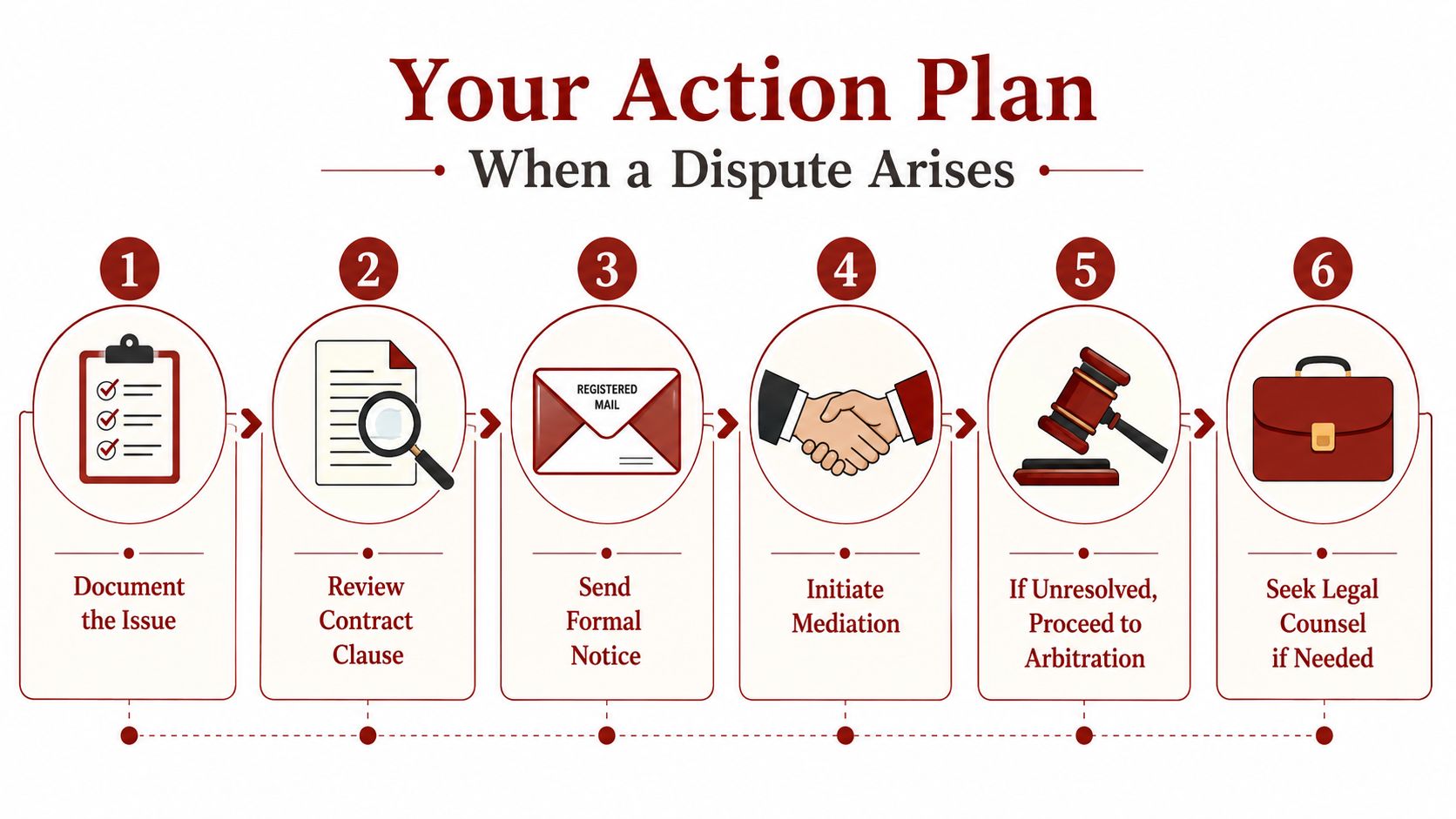
- Document the condition. Photograph the work from multiple angles. Save plans, inspection reports, invoices, schedules, texts, emails, delivery records, and payment confirmations. Keep original files and create a chronological project log.
- Read the contract before sending an accusation. Find notice provisions, cure periods, payment-dispute language, mediation requirements, arbitration rules, lien provisions, and termination rights.
- Send formal notice correctly. Use the delivery method the contract requires. Identify the specific problem, the work affected, the contractual basis, and the remedy you're requesting.
- Protect the property. If exposed materials, water intrusion, unsafe conditions, or threatened removal of equipment create immediate risk, seek legal advice about emergency relief. Don't make destructive repairs that erase evidence unless safety requires action.
- Initiate mediation promptly. Propose qualified construction mediators and several available dates. Keep the invitation practical, but reserve your rights and state that participation doesn't waive claims.
- Prepare for the next forum. If mediation fails, organize the evidence as though arbitration has already begun. Preserve expert observations, cost records, communications, and proof of your own compliance.
Make mediation productive
Bring a concise chronology, the contract, disputed drawings, change orders, payment records, photographs, and a settlement proposal. Separate what you need to finish the building from what you want as compensation. A mediator can work with a practical completion plan more effectively than a demand that merely labels the builder dishonest.
Set a decision deadline for yourself, not necessarily an ultimatum for the other side. Know the maximum additional amount you're willing to spend, the repairs you'll accept, and the terms you need before releasing claims. If the builder attends only to delay, document that conduct and ask counsel whether the clause allows you to proceed.
When to Bring in an Attorney
You don't need a lawyer for every disagreement about a trim detail or a scheduling conversation. You do need one when the dispute can affect the building's safety, your land, your financing, or your ability to recover anything from the builder.
Bring in counsel early when you see structural movement, foundation concerns, water intrusion, nonconforming work, major deviation from engineered plans, or a threatened lien. Those problems are difficult to value and easy to make worse through an improvised repair or careless admission. A construction attorney can help preserve evidence, coordinate an appropriate expert, and send notice without making statements that undermine your position.
Attorney involvement also makes sense when the builder demands a substantial change-order payment, threatens to stop work, asserts that you caused the delay, or proposes a release before correcting defective work. Don't sign a broad waiver just to get the crew back on site. A release can eliminate claims you haven't yet discovered.
Spend legal dollars where they change leverage
A lawyer can do more than argue during mediation. Counsel can:
- Interpret the clause: Determine whether notice was sufficient, mediation is a condition precedent, or arbitration is enforceable.
- Value the claim: Separate completion costs, repair costs, delay losses, credits, retainage, and disputed extras.
- Test technical positions: Work with engineers and inspectors to distinguish code, plan, and workmanship issues.
- Draft enforceable settlement terms: Address deadlines, access, payment, warranties, releases, lien waivers, confidentiality, and consequences for nonperformance.
- Prepare the escalation: Preserve the record if arbitration becomes necessary.
Choose someone who handles construction disputes and understands rural projects, post-frame methods, subcontractor relationships, and local lien law. A general practice lawyer may be capable, but this is not the place to learn construction procedure from the file.
If the builder appears insolvent, stops communicating, abandons the site, or has multiple unpaid subcontractors, act immediately. A favorable award is not a substitute for a collectible defendant.
Key Questions to Ask Builders Before You Sign
Ask these questions before you pay a deposit or approve a final contract. You're not trying to create hostility. You're finding out whether the builder has a workable process for the day the project doesn't go according to plan.
Questions about experience and process
- Have you participated in mediation or arbitration involving a construction project? Ask what kind of dispute it involved and whether the process produced a workable result.
- What dispute clause do you normally use? Request the actual language, not a summary from a salesperson.
- Will you agree to mediation before arbitration? A reasonable builder should be able to explain why it accepts or rejects a staged process.
- Who selects the neutral? Require mutual selection or appointment by an independent organization.
- Which rules apply? The contract should identify the arbitration institution or procedural rules clearly.
- Where will the proceeding occur? The location should bear a sensible relationship to the land, parties, and project records.
Questions about money and protection
Ask whether the builder carries appropriate liability insurance and whether subcontractors are insured. Ask whether the builder uses surety bonds on projects where bonding is appropriate, and request documentation you're entitled to review before signing.
Find out whether the builder can suspend work during a dispute, whether you must continue paying undisputed amounts, and how the contract handles defective work. Ask when the builder will provide lien waivers and what happens if a subcontractor claims nonpayment.
Before you sign, insist on answers you can verify in the contract, not assurances that depend on a friendly conversation.
Finally, ask what happens to unfinished work if the contract ends. The clause should address site access, stored materials, plans, permits, inspection records, payment reconciliation, and transition to another contractor. If the builder refuses a neutral dispute process, avoids insurance questions, or insists on a one-sided arbitration clause, treat that as a serious warning. You're still free to choose another builder before your money and property are tied up.
BarndoBuilderList helps you build a cleaner shortlist of barndominium-friendly builders, review scope and service-area information, and prepare better questions before signing a contract. Visit BarndoBuilderList to compare researched builder profiles and start your due diligence with dispute resolution in mind.
- mediation and arbitration
- barndominium contracts
- construction disputes
- ADR clauses
- builder agreements