Builder Checklist for Barndominium Buyers: What to Verify
Use this builder checklist to vet barndominium builders: documents to request, questions to ask, shell vs turnkey scope and red flags to avoid.
You've found land, saved floor plans, and started getting builder quotes. One proposal looks affordable, another is much higher, and both promise a complete barndominium. Before you choose the cheaper bid, find out whether complete means an enclosed shell or a finished home with working utilities and approval to occupy.
A useful builder checklist makes those differences auditable before you pay a deposit. It connects every scope item to a responsible party, a price or allowance, and evidence you can check. Attractive project photos can earn a builder a phone call. They can't establish what your contract buys.
Table of Contents
- The Builder Vetting Checklist at a Glance
- Checking Builder Claims With BarndoBuilderList Profiles
- Who Owns What
- Questions to Ask Every Builder Before You Shortlist
- Documents to Collect and What Each One Proves
- Confirming Permits and Financing Before Any Deposit
- Deciding to Hire, Pause or Walk Away
The Builder Vetting Checklist at a Glance
Work through the gates below in order. Scope comes before price, because quotes aren't comparable until they describe the same finished result. Credentials, insurance, and relevant experience then establish whether the contracting business is a credible candidate.
Treat this as a pass-or-pause process, not a scoring contest. Excellent references don't compensate for missing insurance, and a detailed estimate doesn't resolve an unworkable permit path.
Six gates for vetting a barndominium builder
| Gate | Core question | Proof to request | Stop signal |
|---|---|---|---|
| Scope | Is shell, weather-tight shell, or turnkey defined in writing? | Signed inclusions and exclusions list | Scope described only as complete or all-inclusive |
| Credentials | Is the required license active under the contracting name? | Freshly dated official license lookup | Builder hesitates to share a license number |
| Insurance | Are general liability and workers' compensation current? | Certificate of insurance naming you as certificate holder | Expired certificate or unexplained missing workers' compensation |
| Experience | Has the builder finished similar-sized barndominiums? | Project addresses, dated photos, and client contacts | Only renderings or stock images offered |
| Price | Do competing bids describe the same work? | Comparable written bids with matching scope and exclusions | A much lower bid without itemized exclusions |
| Approval | Who confirms permits, inspections, and lender acceptance? | Named permit owner and written local confirmation | Verbal reassurance without supporting documents |
Check licensing or registration against the requirements where you'll build. If the builder claims an insurance exemption, verify it rather than treating the missing coverage as resolved.
Practical rule: Record the result, review date, reviewer, and missing evidence for every gate. A builder with an unresolved gate is paused, not hired.
Set a document deadline that fits the missing item. An expired certificate may be straightforward to replace; an unresolved approval issue needs an answer from the authority responsible, not a promise from the salesperson.
Checking Builder Claims With BarndoBuilderList Profiles
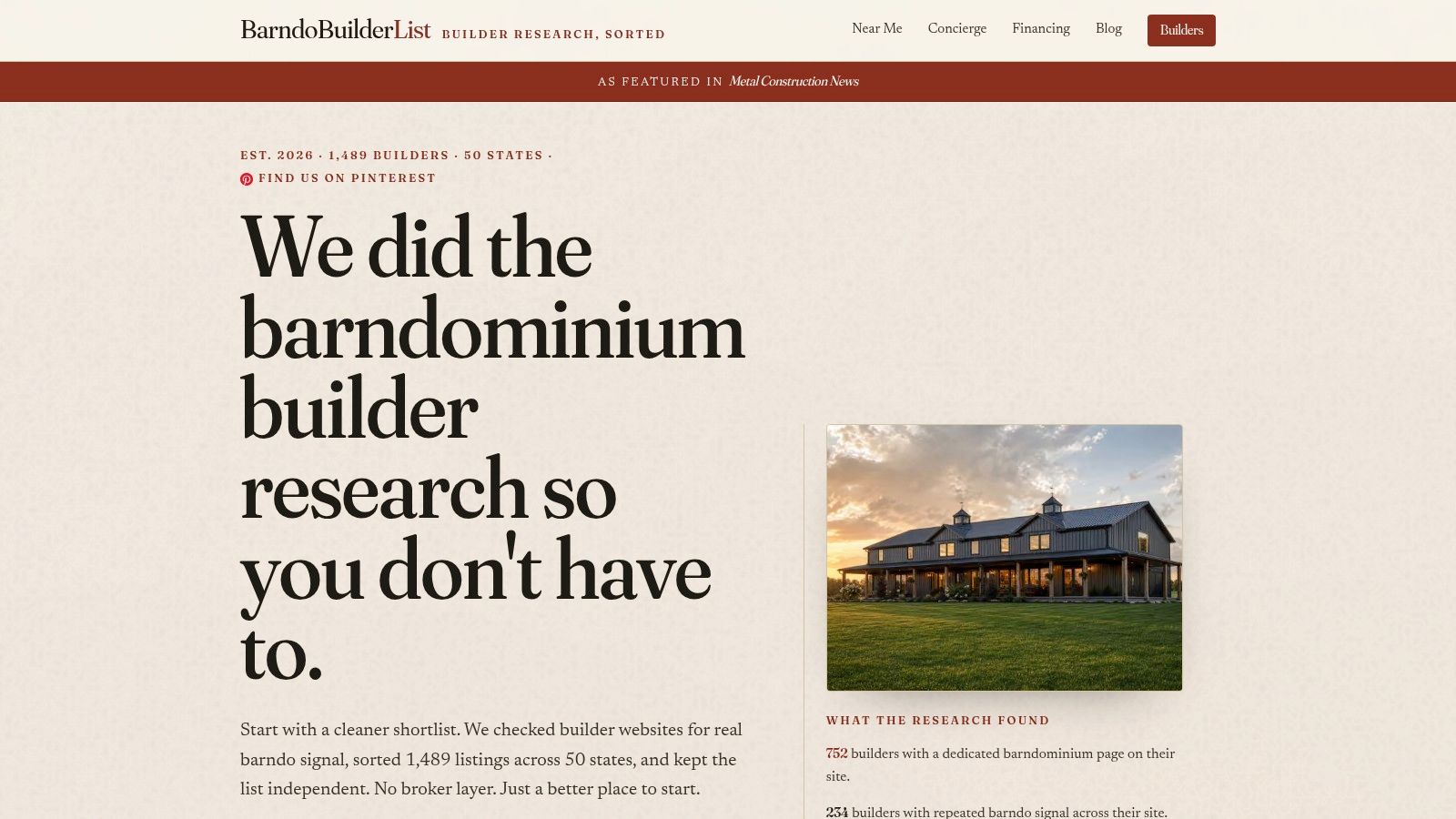
Use the builder directory as one starting point alongside local referrals and contractor-license searches. State pages organize candidates by website signal strength and confidence tier, while ZIP searches help you identify nearby companies through distance-sorted results.
Open each profile and read the focus notes and scope tags first. A company describing shell erection may be relevant to an owner-builder but unsuitable for someone who needs a general contractor to manage the finished residence.
Read the evidence behind the tier
The confidence tier describes the builder's website evidence. It isn't a workmanship rating, financial assessment, or confirmation that the company can take your project.
How to read confidence tiers on a profile
| Tier or signal | What the site shows | How to use it |
|---|---|---|
| Dedicated page | Builder has its own barndominium page with projects, photos, or services | Strongest starting point; still request documents |
| Repeated mentions | Barndominium work appears across several website pages | Request completed-project addresses to verify |
| Single mention | Barndominium appears once, often in a services list | Treat as a lead, not proof of experience |
| Sparse market | No medium-or-better listing found for the area | Read the coverage note and widen the ZIP search |
Follow the profile's source links. Look for completed homes resembling your intended size, structural system, and finish level, then ask what the company performed. A builder may display a finished project while having supplied only its metal shell.
Turn profiles into a calling list
Use review snapshots to identify questions about communication, scheduling, or warranty service, not to deliver a verdict. A positive review about an agricultural building doesn't establish experience managing residential interiors.
Listings are factual summaries, not endorsements. If a profile appears outdated, use the contact workflow to flag the correction or submit stronger project evidence. In a sparse market, widen your search without lowering your document requirements, and take the strongest candidates into direct verification.
Who Owns What
| Scope item | Shell | Weather-tight shell | Turnkey |
|---|---|---|---|
| Engineering and stamped plans | Confirm in writing | Confirm in writing | Usually included |
| Site work, grading, and driveway | Usually excluded | Usually excluded | Confirm in writing |
| Foundation and slab | Usually included | Usually included | Included |
| Roof, walls, windows, and exterior doors | Included | Included | Included |
| Insulation and air sealing | Usually excluded | Included or excluded | Included |
| Electrical, plumbing, and HVAC | Excluded | Excluded | Included |
| Interior framing, drywall, and paint | Excluded | Excluded | Included |
| Flooring, cabinets, and fixtures | Excluded | Excluded | Included |
| Septic, well, and utility hookups | Usually excluded | Usually excluded | Confirm in writing |
| Permits and inspections | Confirm in writing | Confirm in writing | Confirm in writing |
These are comparison patterns, not contract definitions. A shell generally means the enclosed structure; weather-tight delivery should expressly include sealed roof, wall, and opening details. Turnkey should mean a finished home ready for occupancy, but the contract must establish what that includes.
Site work and utility connections deserve particular attention. A finished house price may still exclude clearing, rock excavation, a long driveway, septic installation, or power extended from the road. The turnkey builder guide provides another way to frame delivery-scope questions.
Convert scope into financial controls
Construction represented 64.4% of the average new-home price in 2024, according to the NAHB construction-cost survey. That's a reason to scrutinize the work being purchased, not to assume a barndominium will match that survey's cost structure.
Request a project-specific matrix with columns for included work, excluded work, responsible party, specification, and price or allowance. Replace vague language with an identifiable task, such as utility trenching from the agreed service point to the building.
For provisional allowances, establish what the amount covers and how actual costs will be reconciled. Ask whether labor, delivery, taxes, and builder markup are inside the allowance or added later.
A cheaper shell isn't a cheaper finished home until you've priced the work someone else must complete.
Tie payment draws to defined deliverables and require written approval of price and schedule changes before changed work begins. Compare proposals only after every scope boundary has an owner.
Questions to Ask Every Builder Before You Shortlist
A productive builder call tests how the company will run your job, not how confidently its salesperson talks. Ask every candidate the same core questions and record the answers side by side.
Capacity and relevant experience
Ask who will supervise the site day to day, what other jobs that person manages, and who can authorize corrections. A strong answer identifies the superintendent and explains how you'll communicate, rather than promising constant oversight without naming anyone.
Request recent completed barndominiums, including projects in your county. Separate the company's experience from the proposed supervisor's experience, and ask whether the builder managed the whole home or only a portion.
Trade coordination and money
- Crew responsibility: Who handles the slab, structural erection, and electrical work? Ask for business names and whether crews are employees or subcontractors.
- Trade handoffs: Who checks slab dimensions, anchor locations, and rough-in positions before the next crew arrives? Look for a named coordinator and a documented review.
- Deposit terms: What does the deposit purchase, when does it become nonrefundable, and what happens if approvals fail? Request the actual contract provision.
- Price changes: How are steel or lumber price changes handled after signing? Ask which costs are fixed and which remain adjustable.
- Change approval: Who prepares change orders, how are they priced, and who must approve them before work starts?
A specific answer contains a name, amount, date, or document. Statements about using excellent people or handling everything leave the question unanswered.
Handover and reference checks
Ask who receives warranty requests, how claims are logged, and what response commitment appears in the warranty. Distinguish an acknowledgment from an inspection appointment or completed repair.
During reference calls, ask whether the final cost matched the signed scope, whether changes were approved before work began, and how failed inspections were resolved. Ask whether the builder answered warranty requests within the promised timeframe. Record the client's name, project address, and call date, and mark unreachable references unverified, not satisfactory.
Documents to Collect and What Each One Proves
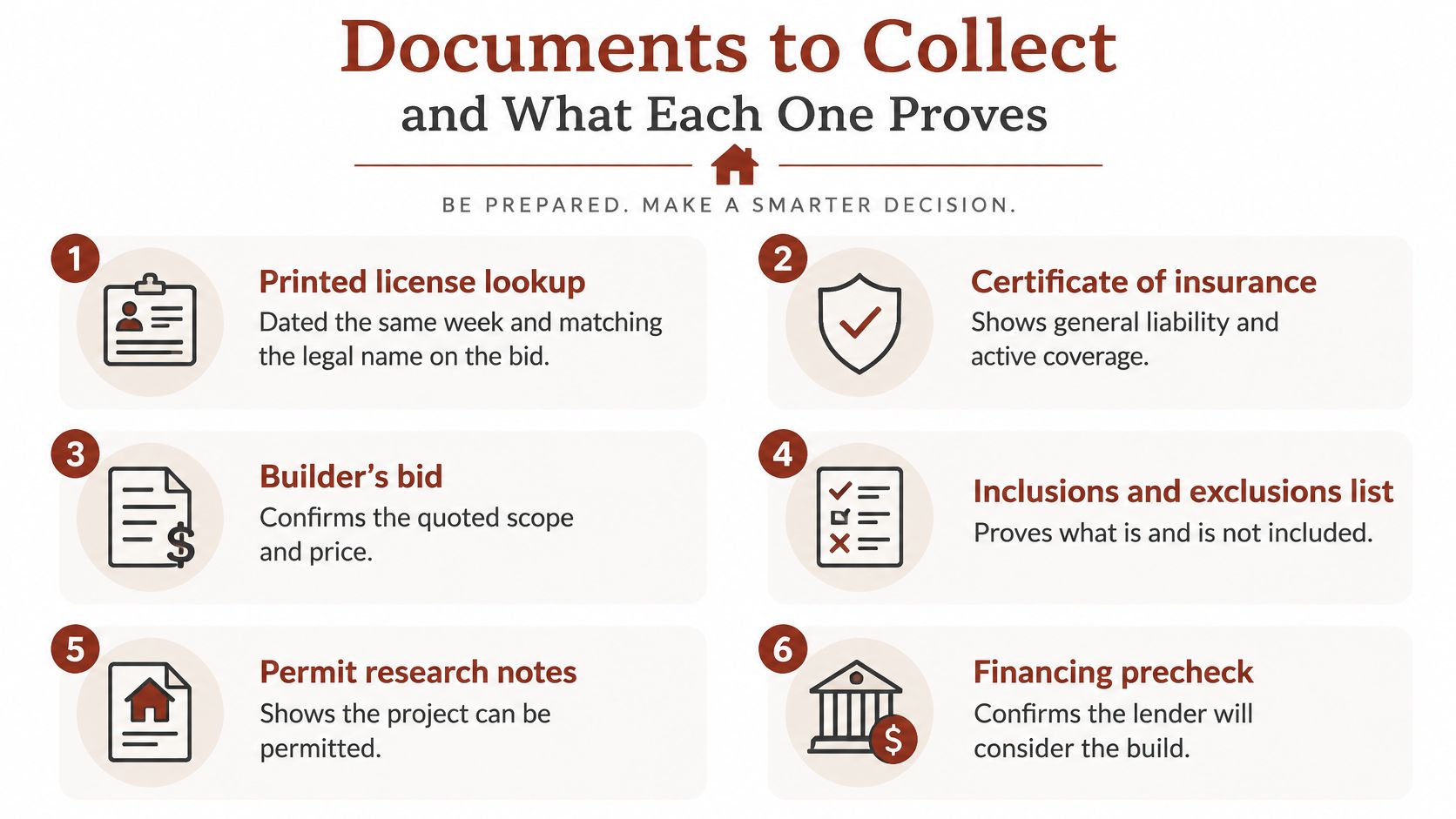
Collect evidence before signing, not after a disagreement. The California Contractors State License Board construction checklist recommends at least three estimates, reference checks, license and insurance verification, and clarification of permit and inspection responsibilities.
Assemble the contract file
- Official license lookup. Save a current result matching the legal name on the bid, because an unmatched or missing record leaves the contracting entity unverified.
- Certificate of insurance. Request general liability and workers' compensation information with you identified as certificate holder, because an absent certificate leaves coverage unconfirmed.
- Comparable written bids. Collect labor, materials, fees, timeline, payment terms, and exclusions in writing, because a total price alone doesn't establish what you're buying.
- Reference list and visit permission. Obtain prior-client contacts and permission to view a completed home where feasible, because project photos alone don't establish client experience.
- Draw schedule and change-order procedure. Require defined payment milestones and written approval rules, because missing terms leave billing and authorization open to dispute.
- Permit and inspection assignment. Identify who submits applications, pays fees, schedules inspections, and arranges corrections, because an unassigned task can delay the project.
- Milestone inspection plan. Require a written sequence of reviews and records, because a final walkthrough can't verify everything concealed during construction.
A certificate holder isn't automatically an additional insured. Ask the insurance agent to confirm coverage dates, named insured, and any endorsements your contract requires.
Keep evidence before work disappears
The inspection plan should address site and foundation work, structural framing and connections, roof and wall weather barriers, windows and doors, rough mechanical/electrical/plumbing, insulation and air sealing, drywall, and final life-safety systems.
Inspection evidence matters: a Builder report on construction defects described an average deficiency rate of 4% across the inspected construction assemblies in the reported dataset. Require photographs, applicable test results, engineer observations, and jurisdictional inspection records before relevant work is concealed.
For a barndominium, specify reviews of engineered connections, roof penetrations, condensation-control details, and separation between living and workshop areas. Assign every deficiency a correction owner, deadline, and close-out record.
If a document can't be tied to a named person and a date, treat it as unresolved evidence. Keep a folder per builder, preserve proposal revisions, and make sure the signed contract incorporates the final drawings, specifications, scope matrix, and warranty.
Confirming Permits and Financing Before Any Deposit
A builder can accept your project while the county, lender, appraiser, or insurer cannot. Before paying for stamped plans, engineering, or a nonrefundable builder deposit, establish which approvals are available and what information remains necessary.

Some final approvals require developed plans. The practical goal is written preliminary confirmation and clearly identified conditions, not a promise that an undeveloped concept already has final approval. The barndominium financing guide outlines the coordinated plans, specifications, budget, contract, and insurance documentation these projects can require.
Ask the local authority
- Residential use: Is the proposed dwelling allowed on this parcel, and which setbacks and minimum dwelling standards apply?
- Code path: Which building requirements apply to the structural system and the attached shop?
- Site services: What septic, well, access, or utility approvals are needed?
- Occupancy: What must be completed and documented before a certificate of occupancy can be issued?
Describe the intended workshop activity accurately. Say you plan to operate a business there rather than using the space only for personal storage. That distinction may change the authority's answer.
Ask the lender and insurer separately
- Lender acceptance: Will the lender consider this construction type, builder, location, and residential/workshop arrangement?
- Valuation and draws: What appraisal approach, budget detail, reserves, and inspection records will the lender require?
- Insurance acceptance: Can the insurer cover construction and the completed property, including the intended shop activities?
Use the construction-loan guide to prepare lender-specific questions. Don't assume a lender's preliminary interest establishes insurance availability.
Keep an approval log showing the contact, agency or company, date, written response, conditions, and next action. Rural locations also need confirmation that utility providers and relevant trades can serve the parcel. The approval log, not the builder's enthusiasm, should support the next payment.
Deciding to Hire, Pause or Walk Away
The builder with the most appealing portfolio isn't automatically the builder you should hire. Your decision should reflect whether the company can deliver your particular project under terms you can verify.
Hire when the evidence agrees
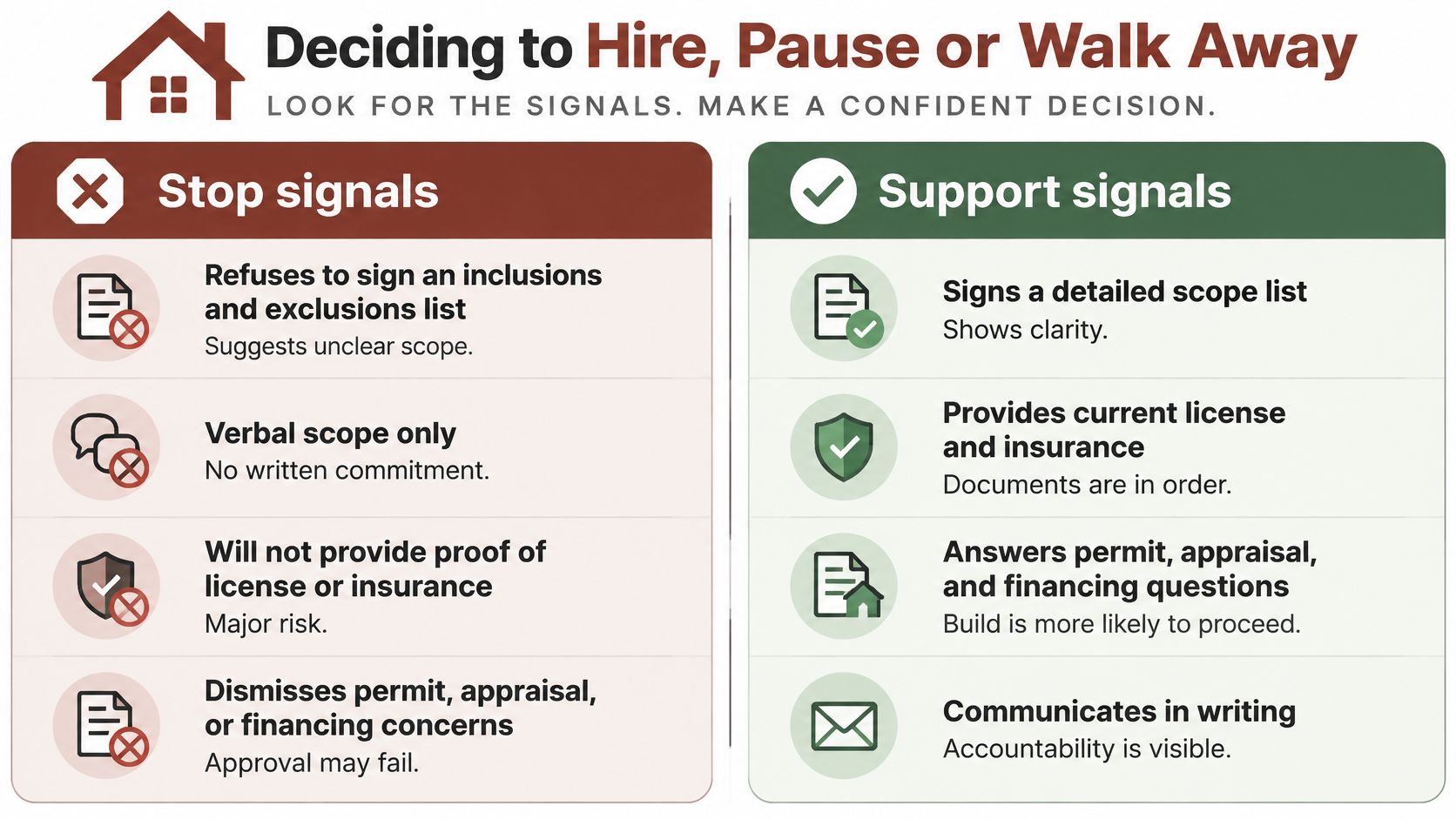
Hire only when every gate passes in writing and the documents describe the same project. The builder's legal name should match across the agreement and supporting records; the drawings, scope matrix, allowances, and payment schedule should be consistent.
Passing individual checks isn't enough if the documents contradict each other. A proposal that includes insulation and a contract that excludes it leave a material issue unresolved, even when each document looks professional.
Decision test: Could someone who missed every sales conversation read the final agreement and identify what will be built, who will do it, and what triggers payment?
A clear answer supports hiring. Any important assumption that exists only in conversation needs to become a contract term first.
Pause for a correctable gap
Pause when a specific document can resolve the outstanding issue and the builder cooperates. Identify the missing evidence, assign responsibility, and agree on a delivery deadline.
Don't let a pause become authorization to start. Avoid approving material orders or accepting nonrefundable obligations while the underlying gate remains unresolved. If an early purchase is necessary, document ownership, storage, cancellation terms, and the financial consequence of approval failure.
Walk away from refusal
Walk away when the builder refuses reasonable documentation, dismisses approval concerns, or substitutes phone assurances for agreed scope. Pressure to sign doesn't improve an incomplete contract.
Be proportionate about administrative gaps. A certificate that needs updating is different from a builder who won't let you verify coverage; a delayed reference call is different from references whose connection to completed projects can't be established.
Build a shortlist from state or ZIP results, apply the same checks to each candidate, and maintain a comparison sheet with evidence locations and unresolved issues. Choose from the builders who qualify, rather than choosing a favorite and excusing what's missing.
BarndoBuilderList offers state and ZIP searches, builder profiles, scope tags, and source links to help you identify candidates for verification. Visit BarndoBuilderList, assemble your shortlist, and send each candidate the same scope matrix and document request before discussing a deposit.
Related builder lists
These state and metro pages match places named in this article.
- builder checklist
- barndominium builder
- shell vs turnkey
- vet barndominium builder
- barndominium contractor