10 Best Questions to Ask Barndominium Builders in 2026
Find the best questions to ask a barndominium builder about experience, scope, costs, timelines, and project fit, plus what strong answers sound like.
Two buyers call the same three builders on the same Tuesday. The first asks, "Do you do good work?" and hears yes three times, then spends a week unable to choose. The second asks for a finished project she can walk through, the permit timeline on the last house this builder finished in the county, and a written line-item scope. By Friday she knows which of the three is a real fit and which is a website with a phone number.
That difference isn't charm or luck. It's question design, and most of the good designs were invented somewhere other than construction. Hiring managers, sales researchers, therapists, and risk planners have spent decades working out how to get a specific answer out of a person who is motivated to give a smooth one. Each method below does the same job for you: it moves the conversation from claims to evidence, on a project where the claims cost six figures and the evidence is a house you'll live in.
Start with a shortlist from a state or ZIP search, then use these ten questions to decide who earns a site visit. If you're working from a directory, treat review-language tags as evidence for asking better questions, not proof that a builder offers a specific service. Every name stays a lead until a person answers.
Table of Contents
- 1. The Mom Test Questions
- 2. The Five Whys
- 3. SPIN Selling Questions
- 4. The Miracle Question
- 5. Motivational Interviewing Open Questions
- 6. Behavioral Interview Questions (Tell Me About a Time)
- 7. Pre-Mortem Questions
- 8. Clean Language Questions
- 9. Socratic Questioning
- 10. Scope-Clarifying Questions for Builders
- How each barndominium builder question compares by style, best use, and main limitation
- Turn Builder Answers Into a Shortlist You Can Verify
1. The Mom Test Questions
Rob Fitzpatrick's 2013 book The Mom Test makes one uncomfortable claim. Ask people about your idea and they'll be polite. Ask about what they did last month and they'll be useful. When you're the buyer, you're the one who has to steer toward last month.
The pattern below turns each conversation into a comparison you can score instead of a gut feeling.
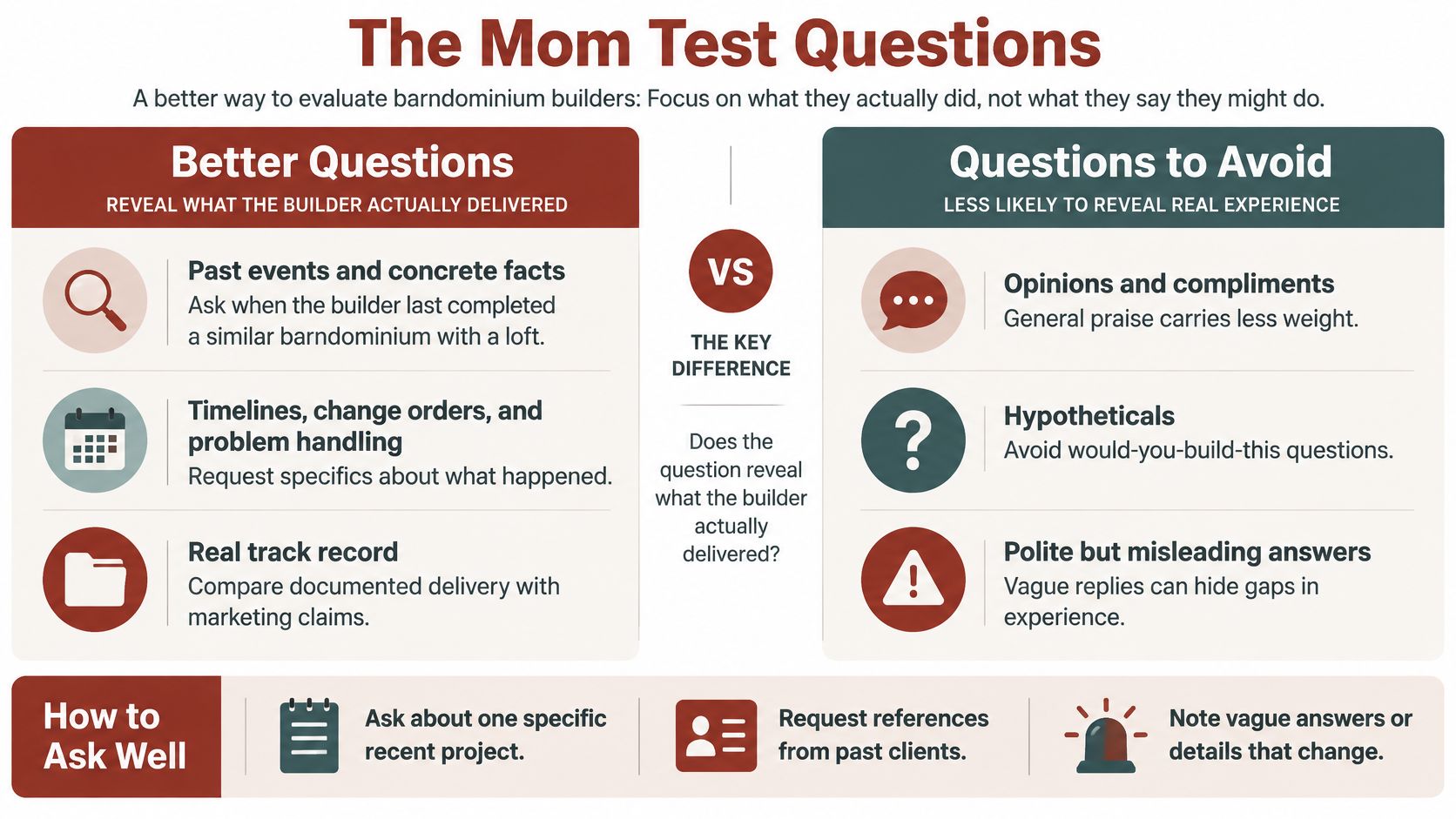
Opinion questions invite sales answers. "Would you include the slab?" gets a yes from every builder who wants the job. "Walk me through the last shell-only project you finished. What was the scheduled completion date, and what happened?" gets a date, a delay, and a reason.
What a good answer sounds like
- A month and a county. "We closed that one in March in Bastrop County" is checkable. "We've done dozens of those" is not a fact, it's an adjective.
- A named subcontractor. Ask which crew poured the last slab and whether they finished on schedule. A builder who coordinates trades should be able to name the ones he hires.
- References offered before you ask. "Here are two owners from 2024, call them" ends the conversation well.
Comparisons are thinner than they feel. In 2024, 42.02% of homeowners compared two contractor quotes and 27.90% compared three, according to Modernize's contractor-selection research. Two bids give you a price range. A structured interview tells you which of the two numbers is real.
2. The Five Whys
A quote lands 20 percent above the other bid, and the instinct is to ask which one is right. The better move is to ask why, roughly five times, the way Toyota's production system taught problem-solvers to do it. Root-cause chains look like this.
"Why is your number higher?" Because the price includes a reinforced slab. "Why?" Because the soils on your lot test poorly. "Why that foundation?" Because the engineer specified it for the site.
That's a cause you can check against a soil report and a stamped drawing, and it's a cost worth paying. The bidder who leaves the slab out isn't cheaper. He has moved the cost to you and left the decision in your lap.
The chain works on schedules too. Why is the finish date months later than the other builder's? Because of well and septic approvals. Rural projects may need separate well and septic permits, and soil conditions can force an engineered system that costs more, as Texas Farm Credit's barndominium guidance notes.
Here the method is worked through step by step.
- Ask curious, not accusatory. "Help me understand this line" gets an explanation. "Why is this so expensive?" gets a defense.
- Stop at something verifiable. A soil report, a permit record, a delivery lead time. If the chain ends at "that's just how it is," you've found the edge of the builder's knowledge.
- Run the chain with three builders. Same item, same question. The two who give matching causes are probably describing your site. The outlier is describing a template.
3. SPIN Selling Questions
Neil Rackham built SPIN from research on large sales, and the order is the whole trick: Situation, Problem, Implication, Need-payoff. Each question earns the next one, so the builder ends up explaining consequences instead of quoting features.
Situation comes first. "How long does a slab usually take to pour for a 40 by 60 shop?" Then the problem. "What happens to the schedule if the site stays wet?" Then the implication, which is the question buyers skip. "How much does a delay like that add to the final cost?" Finish with need-payoff. "If we pour in June, does that hold your closing date?"
The sequence matters because buyers decide through evidence, not through one conversation. A consumer-research summary reports that 78% of consumers begin their purchasing journey online, even when the transaction closes offline, and that up to 40% change their minds during evaluation after encountering new information, according to Zoho's consumer decision-making research summary. Ask each builder what would change his recommendation. The one who says "nothing" has told you something useful.
Watch for the missing implication. A builder who never asks what a delay would cost you is selling a package, not planning your build.
The same four steps work on money. Situation facts such as land equity, draw schedules, and the documents a lender will ask to see belong in the first call, not the last, and our guide to questions to ask lenders covers what to bring.
4. The Miracle Question
Solution-focused brief therapy produced a question that transfers almost unchanged to construction. "Imagine that tonight, while you sleep, the build is finished and it went the way you hoped. What's the first thing you notice tomorrow morning?"
Write the answer down before you call anyone. It's more specific than a mood board.
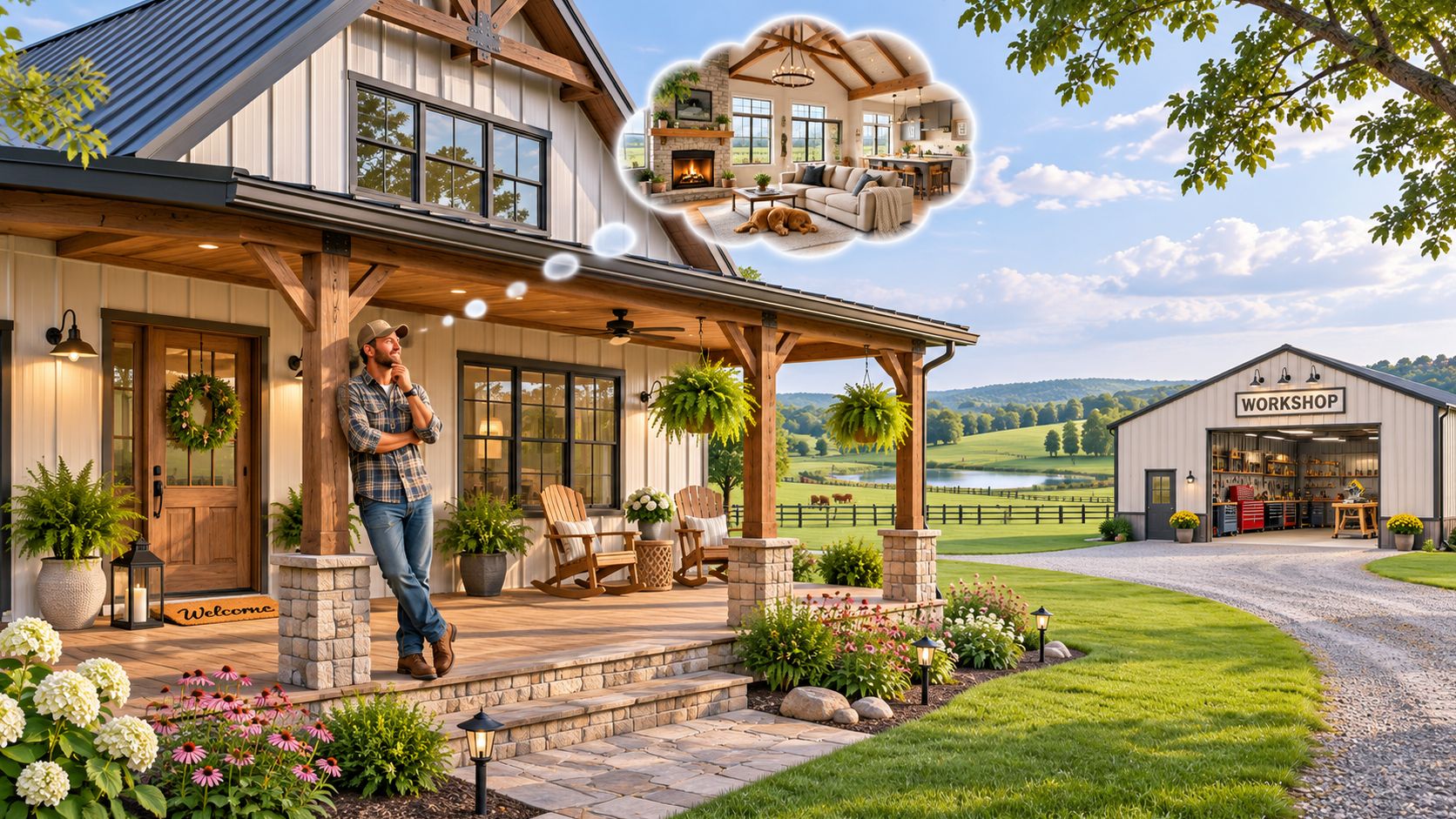
Say you picture coffee at a bench in the shop while someone else is still asleep upstairs. That single image just decided your wall assembly, your insulation, and where the office goes. A rural landowner might find that the first sign of success is parking equipment indoors during a January storm, which settles door height, slab thickness, and whether the apron gets poured before winter.
Ask the builder the same question
"Imagine this project a year after move-in and it went well. What does that look like?" The answer shows whether the builder thinks in finished rooms or in deliverable packages. Then follow with "What's one small step that would show progress?" You want a step this week, such as a site visit with a laser level or a draft scope. A builder who answers with a contract signing has heard the question as a closing technique.
The point isn't the fantasy. It's the specification you extract from it before anyone quotes a number.
5. Motivational Interviewing Open Questions
William R. Miller and Stephen Rollnick built motivational interviewing around open questions, and the mechanic is simple. A closed question returns a yes and ends the topic. An open question returns a paragraph, and paragraphs contain the thing you need.
Compare two versions of the same inquiry. Closed: "Do you handle septic?" Answer: yes. Open: "How do you usually coordinate septic and well work on a rural lot?" Answer: who pulls the permit, whether the soils were tested before the plan was drawn, and whether an engineered system is inside the quote or added later.
- Ask one, then stop. Silence after a question is pressure the other person fills with detail. Filling it yourself wastes the question.
- Restate the answer in your own words. "So the grading is the part that worries you." You'll hear a correction, and the correction is the answer you needed.
- Follow the answer into a technical question. Whatever surfaced becomes the next item on your list.
"What worries you most about building on a rural lot?" is the highest-yield opener I know for a first call. The answer is often access, not budget. Winter access off a county road decides driveway base depth, culvert sizing, and whether the builder has ever graded a sloped approach. None of that appears in a per-square-foot price, and all of it appears in your first winter.
6. Behavioral Interview Questions (Tell Me About a Time)
Hiring panels stopped asking "are you good under pressure" years ago. They ask for a specific time you were, and they listen for the result. The format has a name, STAR: situation, task, action, result. Use it on builders.
"Tell me about a time a material delivery was delayed. What did you do, and how did the client find out?" and "Describe a project where the budget changed midway. How was that change documented and approved?" Both questions force a story with dates in it. Vague answers collapse under the follow-up.
The stakes aren't hypothetical. A 2025 residential new-construction customer-experience report covering more than 350,000 homebuyer survey responses found satisfaction at 92.8% during sales but only 75.8% during the warranty phase, with "would recommend" scores falling from 97% at purchase to 71% after move-in, according to ECI Solutions' summary of the 2025 report. The sale is the easy part to enjoy.
Homeowners already shop this way elsewhere. In 2024, 67% said they were most likely to gather three quotes before choosing a roofing contractor, per Roofing Contractor's homeowner survey. Apply at least that standard to a project many times larger.
The reference call is part of the interview
Request two references from projects completed at least 12 months earlier, not the owners from last month. Ask those owners about punch-list completion, communication after final payment, change-order fairness, and whether the house performed as specified. Our guide to questions to ask a barndominium builder breaks the same interview into scope, timeline, and reference-check sections you can take into the call.
7. Pre-Mortem Questions
Gary Klein described the pre-mortem in Harvard Business Review in 2007. Instead of asking what might go wrong, the group assumes the project already failed and works backward to the reasons. It works because imagining a failure is easier than predicting one.
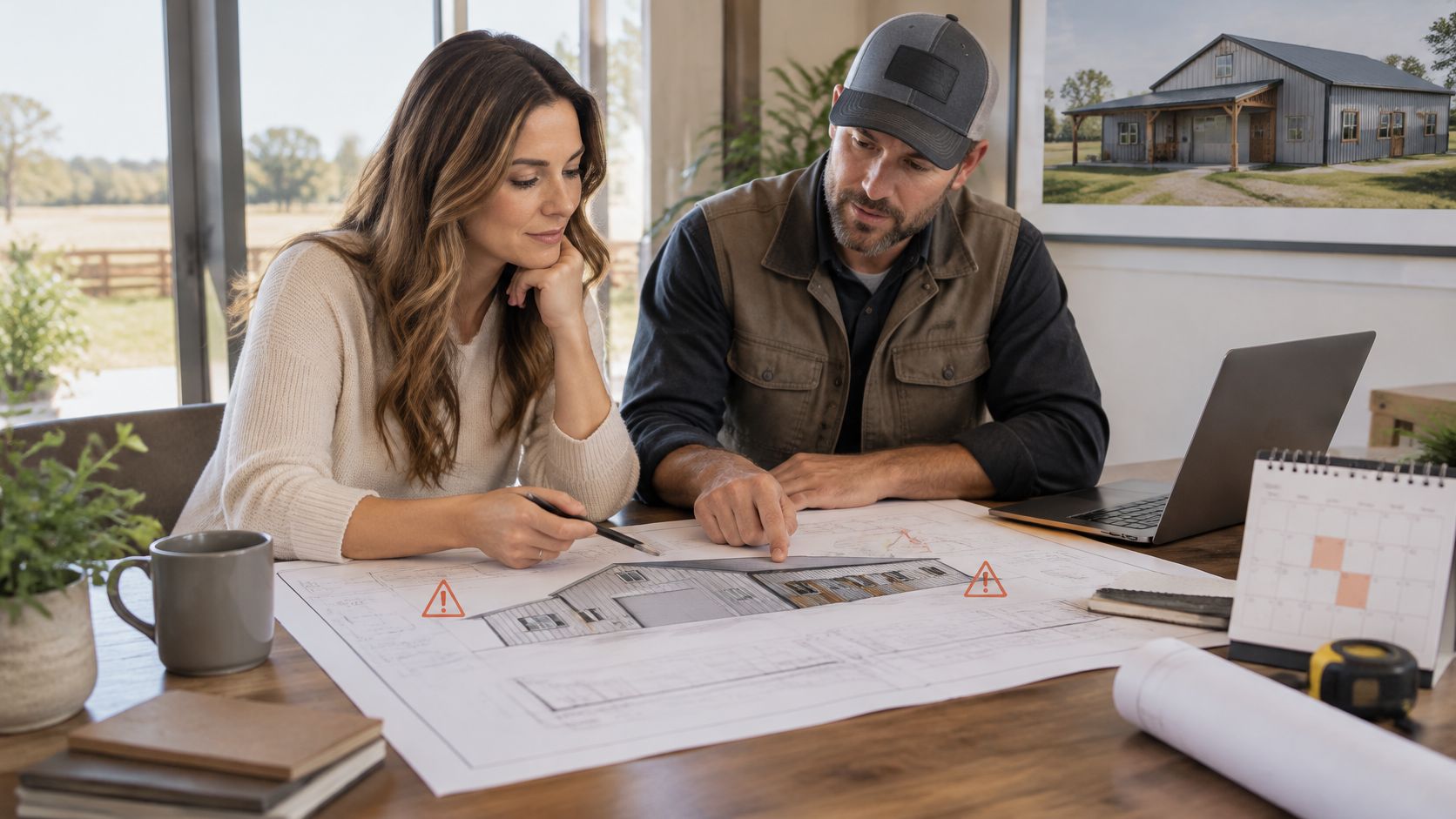
Ask a builder this. "It's eighteen months from now and this build failed. What's the most likely cause?" Then ask for three, not one. A builder who names permit review times and proposes a contingency clause is planning. A builder who says "we've never had a problem" has ended the interview, whether he knows it or not.
Disputes usually start in paperwork rather than concrete. A 2025 California Contractors State License Board newsletter identifies inadequate written documentation of post-contract changes as one of the most common sources of homeowner-contractor disputes, as the CSLB summer 2025 newsletter reports. That's a failure mode you can price in advance.
Turn answers into contract items
Each named failure point becomes a line item or a schedule checkpoint: a written change-order threshold, a communication cadence during framing, a benchmark date for permit submission. Ask how the builder would tell you about a problem in week three rather than week thirteen. Our barndominium cost guide covers which line items typically move and why, so you can recognize the shift while it's small.
8. Clean Language Questions
David Grove's clean language method has one rule. Use the other person's words and don't add your own. A vague word stays vague until the speaker unpacks it, and your interpretation of "airy" is not their interpretation.
A buyer says she wants an "airy" living room. The builder asks, "And what kind of airy is that?" She answers: tall ceilings, windows on the south wall, nothing over the seating. Three decisions arrived in one sentence. A designer asks, "And what would you like to have happen in that space?" and learns the mudroom exists to keep work clothes out of the house, which changes the door swing and the flooring choice.
Try it on a spec sheet. Every time you read a word you can't draw, ask what kind of that it is before you sign.
- Mirror the exact word. Not "spacious," not "open plan." Repeat theirs, unchanged.
- Ask for an example. "Tell me about a room you've been in that felt that way." Now you have a reference, and references convert into dimensions.
- Carry the clarified terms into the plan review. When the drawings come back, check them against the words she used, not the words in the brochure.
9. Socratic Questioning
Classical Athens got there first. Socrates, who lived roughly 470 to 399 BCE, used sequences of questions to test definitions, expose contradictions, and see whether a claim could be justified, a method preserved through Plato's dialogues because Socrates wrote nothing himself, as the Encyclopedia.com entry on Socratic dialogue and dialectics explains. Richard Paul and Linda Elder later sorted the categories into clarification, assumptions, evidence, and implications, which is a workable checklist for a builder call.
Apply it to the word that costs the most. "What do you mean by turnkey? Does it include appliances, landscaping, and the final clean?" The answer won't match the next builder's answer, and that mismatch is the entire comparison problem. "How do you know a 30-foot clear span is needed?" gets you either an engineering explanation or a shrug. Both are informative.
- Define shell, turnkey, and finish-out before you compare bids. Same words, three different scopes.
- Ask for evidence with a date on it. A stamped drawing, an engineering letter, a sample contract.
- Summarize the answer back. "So turnkey means dried-in plus interior trades, but no appliances." If the builder corrects you, write down the correction.
10. Scope-Clarifying Questions for Builders
"Turnkey" isn't a standard. It's a word each builder fills in privately, and the price gap between two quotes often measures the word, not the work. California's transportation department treats scope, contract limits, mobilization, cost impact, and schedule impact as separate decision points when deciding whether proposed work belongs inside an original contract, as its Caltrans change-order guidance sets out. A house deserves the same discipline.
Ask this exactly: "Which of these are in your price and which are mine: site clearing, excavation, foundation engineering, slab, shell erection, insulation, windows, mechanical systems, interior framing, finishes, septic, well, driveway, permits, and utility connections?"
A bid that stops at a dried-in shell isn't cheaper than a turnkey bid. It's a different project with the coordination left in your lap, and the difference shows up the week you're chasing an electrician and a drywall crew yourself.
Put change control in writing
Require each change order to state the added or deleted work, the revised price, the affected drawings, and the time extension. Ask whether owner substitutions, site conditions, engineering revisions, and code-required work are priced at fixed rates, cost-plus markup, or negotiated quotes. Ask for a schedule of values before you sign anything. The benchmark isn't the lowest first number. It's the proposal you can audit line by line and change only with a stated cost and a stated delay.
How each barndominium builder question compares by style, best use, and main limitation
| Item | Question Style | Best For | Main Limitation |
|---|---|---|---|
| The Mom Test Questions | Specific questions about past behavior and projects | Verifying a builder's real track record | Can feel blunt and needs follow-up |
| The Five Whys | Repeated “why” questions to uncover causes | Understanding quote, scope, or timeline differences | May feel repetitive and not reveal a clear root cause |
| SPIN Selling Questions | Situation, Problem, Implication, and Need-payoff questions | Structuring project discovery and clarifying needs | Can feel formulaic or like a sales tactic |
| The Miracle Question | Future-focused questions about the desired outcome | Defining project priorities and a vision of success | Does not directly test builder capability |
| Motivational Interviewing Open Questions | Open-ended questions with reflective listening | Exploring motivations, concerns, and readiness | Takes time and is not suited to technical details |
| Behavioral Interview Questions (Tell Me About a Time) | Questions about specific past situations and results | Assessing how a builder handled real problems | Stories may be polished and require verification |
| Pre-Mortem Questions | Imagine project failure and work backward to identify risks | Surfacing project risks before signing a contract | Depends on candid participation and does not replace due diligence |
| Clean Language Questions | Questions that use and explore the speaker's own words | Clarifying vague style and function preferences | Can feel unusual and is less useful for technical or price issues |
| Socratic Questioning | Questions that examine assumptions, evidence, and implications | Testing builder claims and clarifying scope | Can feel adversarial and lengthen discussions |
| Scope-Clarifying Questions for Builders | Practical questions about inclusions, responsibilities, and written scope | Comparing builder quotes and avoiding scope surprises | Terms vary and detailed answers may require plan or site review |
Turn Builder Answers Into a Shortlist You Can Verify
Run the ten questions in an order. Past experience and real projects come first, because a builder who can't describe one finished build in detail won't perform better on a contract. Scope and costs come second. Timelines and risks come last, once you know which two builders you'd hire.
Before each call ends, get five things: two recent local references, a finished project you can visit, the builder's typical permit timeline in your county, whether the work is shell-only or turnkey, and which parts get subcontracted. Write the answers in the same order for every builder. Identical notes make the comparison mechanical, and they stop the most likeable person in the room from winning on personality.
Two patterns should end a conversation early. A builder who can't name a subcontractor or a recent address is guessing. A builder who gets defensive when you ask for a line-item scope is telling you how the first disagreement will go, because a written scope protects both sides.
The cheapest bid is usually the one with the most work left in it, and the work left in it is yours to coordinate.
If you'd rather not start from a blank page, our state pages list builders sorted by website signal, and the concierge service is free. Describe your build and we'll check with the listed builder and other TX builders on your behalf, so your first call is with someone who already fits the scope you need.
None of this takes long. Ten questions, three builders, one afternoon of notes. The interview is the cheapest part of the project, and it's the only part that happens before the money leaves.
BarndoBuilderList is a research-driven directory of 1,512 barndominium-friendly builders across all 50 states, with state pages, ZIP code search, and buyer guides on turnkey and shell scope. Pull a shortlist for your county, then bring these ten questions to every call and compare the answers on identical terms. Tell us about your build at BarndoBuilderList and we'll help you narrow the field before you commit.
Related builder lists
These state and metro pages match places named in this article.
- questions to ask
- barndominium builders
- builder interview questions
- barndominium construction
- home builder questions