Barndominium Shell Prices by Scope in 2026
Barndominium shell prices in 2026 span $15 to $75 per square foot. Compare kit, erected, and turnkey scopes before you trust a headline quote.
A materials-only steel shell package runs about $15 to $25 per square foot for 2026, an erected shell on a slab lands near $30 to $50, and a weather-tight post-frame shell reaches $45 to $75, which means two honest quotes for the same 2,000-square-foot building can sit $110,000 apart. That gap isn't a bargain waiting to be found. It's a scope gap.
The most repeated advice in this market is to gather three shell quotes and compare them by price per square foot. That advice damages budgets, because the lowest advertised number usually buys the fewest included scopes, not the cheapest finished barndominium. A quote that looks $70,000 cheaper often leaves the slab and the erection crew sitting on your side of the ledger.
Table of Contents
- Barndominium Shell Prices per Square Foot
- What a Shell Includes and What Stays Unpaid
- Cost Drivers Beyond the Kit Price
- Quote Risk When Steel Prices Move
- A 2000 Square Foot Shell Price Example
- How to Line Up Shell and Turnkey Quotes
- Shortlist Builders Who Price the Same Scope
Barndominium Shell Prices per Square Foot
Two quotes for the same 40-by-50 footprint can both be honest and still differ by six figures. The shell cost guide from Buildings Guide reports a materials-only steel shell package, typically framing, roof and wall panels, hardware, and sometimes exterior doors, at approximately $15 to $25 per square foot in 2026. On a 2,000-square-foot structure that equals roughly $30,000 to $50,000, before foundation work, erection labor, insulation, utilities, or interior finishes.
Add the slab and a professional crew and the published picture rises. The same guide cites one national estimate of an erected post-frame shell at $45 to $75 per square foot and another of an erected shell on a slab at $30 to $50 per square foot. Three ranges, one footprint, no contradiction. Each number describes a different point where the seller stopped working.
| Scope | Dollars per sq ft | Cost at 2,000 sq ft | What that price usually covers |
|---|---|---|---|
| Materials-only steel package | $15 to $25 | $30,000 to $50,000 | Framing, roof and wall panels, hardware, sometimes doors |
| Erected shell on a slab | $30 to $50 | $60,000 to $100,000 | Slab plus professional erection |
| Erected post-frame shell | $45 to $75 | $90,000 to $150,000 | Slab, assembly, roof, siding, weather-tight enclosure |
A $40,000 quote may describe only a delivered kit. A $100,000 to $150,000 quote for the same 2,000 square feet may already include the slab, structural assembly, roof, siding, and a weather-tight enclosure. Same square footage, same county, different product entirely.
And none of it makes the building livable. Plumbing, electrical, HVAC, insulation, drywall, flooring, kitchens, and bathrooms generally remain outside the shell scope, and one industry estimate assigns approximately 25% of total completed-project cost to the shell and structure, with the remaining 75% going to interior systems and finishes. Read that twice before you pick a builder based on a low shell rate.
The row test: match every incoming bid to a row in that table before you compare totals. Two numbers from different rows aren't competitors.
Scaling the Bands to Your Own Footprint
Multiply the per-square-foot rate by floor area and the bands travel to any size. A 1,500-square-foot plan at $30 to $50 per square foot is $45,000 to $75,000 for an erected shell on a slab. A 3,000-square-foot plan doubles that before you add a single window or door.
What the arithmetic can't do is price your site. These are national published ranges, not a bid for local wind exposure, snow load, or the soil under your slab. Treat them as the shelf you shop from, then make a local builder put a real number against your address.
What a Shell Includes and What Stays Unpaid
The question that settles most shell-price arguments is short. What's included here, and what will I still have to buy before interior work can begin? The barndominium cost breakdown from BarndoFinder makes the problem visible. Published estimates run from roughly $20 to $35 per square foot for a materials-only kit to $30 to $50 for an erected shell, while a third estimate puts an erected shell with slab at $45 to $75 per square foot. Those figures aren't comparable, because shell may or may not include the foundation, erection labor, windows, exterior doors, engineering, delivery, permits, or site preparation.
Picture the shell as a raincoat for the frame. It keeps weather off the steel and lumber so interior trades can begin, and it is not a place to live. Every quote you receive stops at some layer of that raincoat, so your job is knowing which layer.
The Layers, in the Order a Quote Stops at Them
The building package is the post-frame or steel skeleton with roof panels, wall panels, trim, and fasteners. Freight moves that package from the plant to your land, and delivery to a freight terminal is not delivery to your driveway. Engineering is the stamped design covering span, openings, and the loads your county enforces.
The foundation, usually a slab, is a separate structure the frame bolts to. Erection is the crew, the lifts, and the days that turn a kit into a standing building. Openings are exterior doors and whatever windows the seller agreed to include. Weatherproofing is the moment rain stays outside. Inspections and utility penetrations are handoff points to the trades that follow, never finishes in themselves.
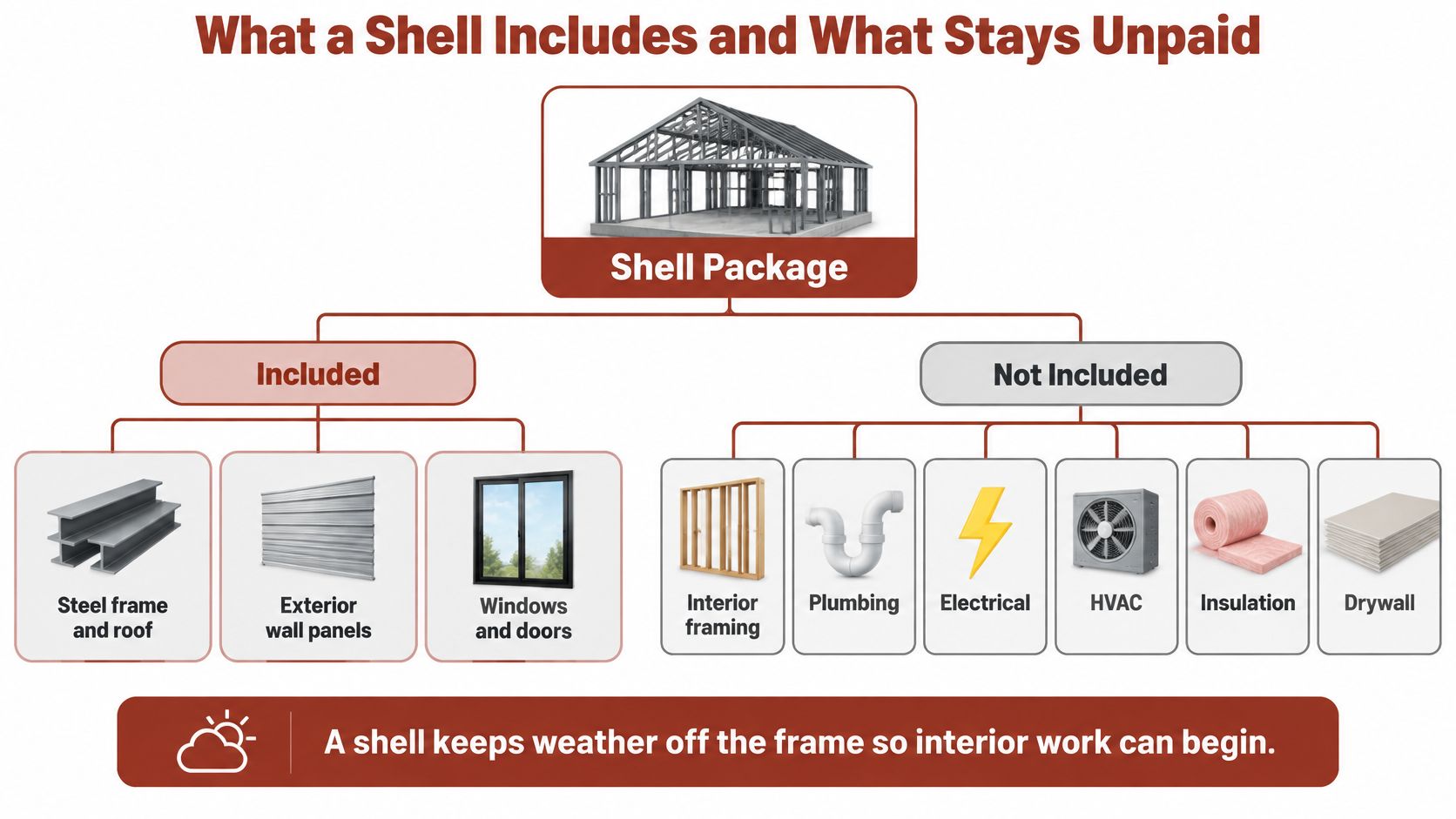
Post-frame, pole barn, metal building, and shouse sellers stop at different layers, so ask each one where their word shell ends. A building standing on a slab with no openings is standing, not dried in. That distinction costs you money two months later, when the door order becomes your problem.
The Line-Item Test for Every Quote
Use the same nine line items on every bid, on one page, so nothing hides inside a lump sum.
| Line item | Often in a low shell ad | Still to buy before interiors |
|---|---|---|
| Building package | Yes | No, if the kit is complete |
| Freight | Sometimes | Confirm delivery to the site, not a terminal |
| Engineering | Sometimes | Stamped plans for local loads |
| Foundation or slab | Rarely in a kit | Yes, until an erected-on-slab quote |
| Erection labor | No in materials-only | Crew, equipment, and travel |
| Windows and exterior doors | Sometimes doors only | Remaining openings and install |
| Weatherproofing | Only in a dried-in scope | Flashing, sealants, and closure |
| Permits and site preparation | Almost never | Buyer, erector, or general contractor |
| Inspections and utility penetrations | Rarely | Required before interior trades |
| Insulation, MEP, drywall, kitchen, baths | No | The finish-out, often most of the home |
What a Weather-Tight Shell Still Leaves You
Even a properly dried-in shell leaves the interior stack untouched. Plumbing, electrical, HVAC, insulation, drywall, flooring, kitchens, and bathrooms all remain unpaid, and that stack is where most of a home's cost lives.
A turnkey scope looks different because one builder prices the shell and the finish-out together, so you aren't hiring a second crew to close the gaps someone else left open. The trade-off is control and price transparency, not scope.
A lower price per square foot can be a shorter shopping list. Ask what got cut before you call it a saving.
Cost Drivers Beyond the Kit Price
Once you've matched a bid to a scope row, other forces still move the number. Size isn't linear. A 30-by-40 shop-house and a 50-by-60 barndominium don't share the same wall-to-floor ratio, and wider clear spans need heavier frames, more steel, and bigger equipment on erection day.
Building Choices That Move the Number
Roof pitch, eave height, and mezzanines all add material and labor. So do openings. Every overhead door, walk door, and window is framing, flashing, hardware, and install time, and a plan with eleven openings prices nothing like the same square footage with four.
Local wind and snow loads can force closer post spacing and upgraded panels even when the floor plan looks identical to one you saw online.
Site Conditions That Move the Number
Slab cost follows thickness, vapor barrier, thickened edges, and soil that needs over-excavation before anyone pours. Site work is the quiet one. A drive, a building pad, drainage, and the distance from the concrete plant can dwarf a small difference between two kit prices, and none of it appears in a shell advertisement.
Labor, Distance, and the Allowance Trap
Erection rises with crew travel, equipment rental, and how many days the building takes, which is why a low kit from three states away can lose to a closer supplier once freight and crew time land. Insulation is its own fork in the road. A pure shell includes none, while a quoted roof and wall package starts looking like finish-out.
The barndominium cost guide we publish walks through these categories in order so you can check your own budget for missing lines. One habit matters more than the rest: ask which figures are allowances and which are firm quantities. An allowance is a placeholder someone else fills in later, and it is not a price.
Quote Risk When Steel Prices Move
How much risk is still sitting in the quote after it lands in your inbox? More than most buyers assume. Steel prices in ENR's 20-city average rose 11.9% during 2025, while the broader Materials Cost Index increased 2.5%, according to the ENR 2026 first-quarter cost report. That gap is the lesson. A double-digit steel move can wreck a shell budget while overall construction materials look calm.
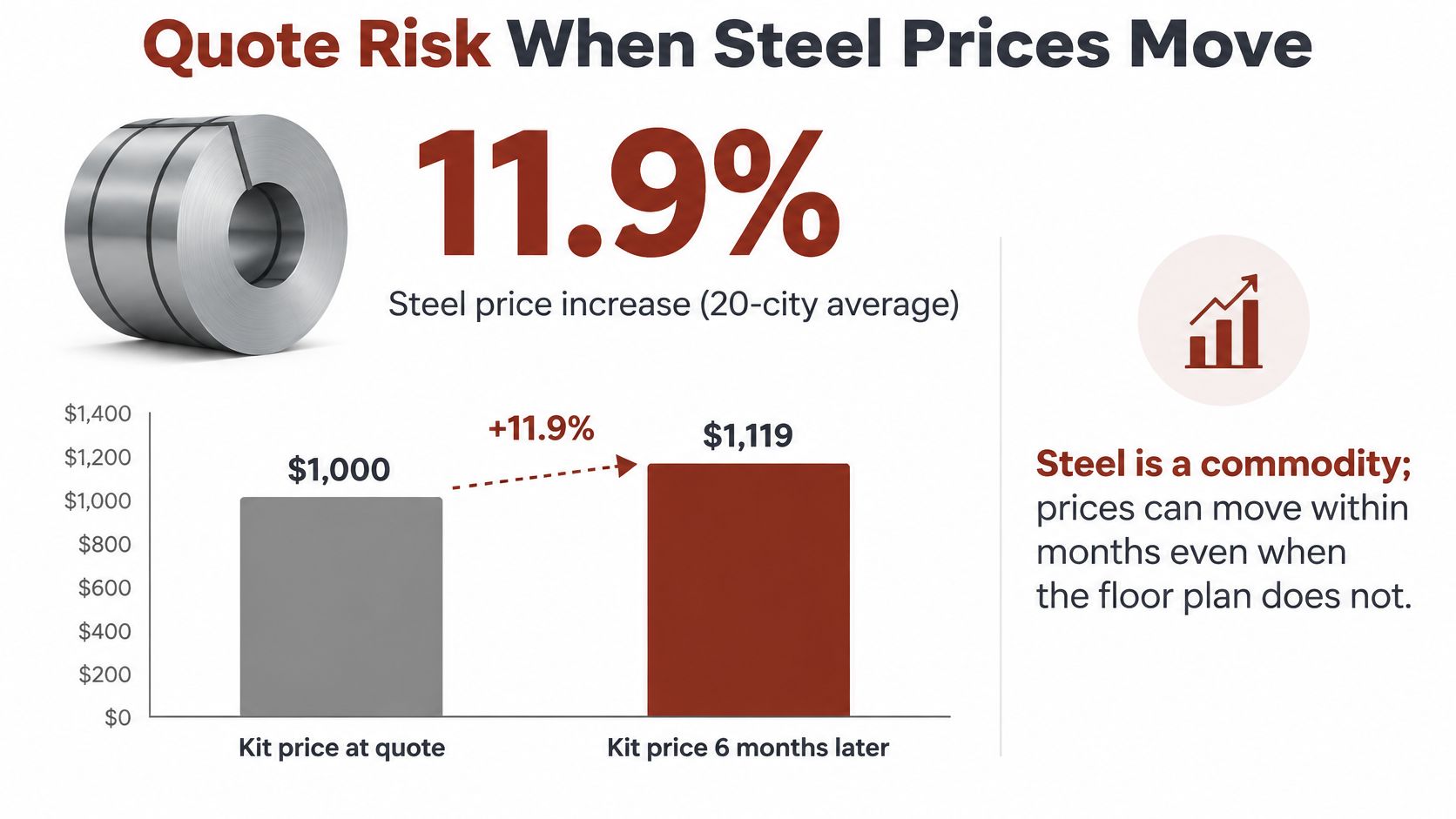
Separate the two exposures in your head. A package quote moves with steel, tariffs, freight, and fuel. Erection moves with crew availability, equipment rental, weather delays, and travel distance, none of which a steel index captures. A locked materials price says nothing about whether the crew shows up in April or June.
The Four Things to Read Before the Total
Look for the quote date, the expiration date, the escalation language, and the delivery assumptions. Then ask the seller four questions.
- Is the price locked? A number without a lock is an estimate wearing a suit.
- How long is it valid? Kit prices can change within months because steel is a commodity.
- Which components are already purchased? Material bought before a tariff change is your protection.
- Who absorbs increases? Tariffs, freight, fuel, and redesign costs need a named owner before you sign.
Reading a Quote as a Contract, Not a Calculator
An online calculator produces a range, and a range is not an offer. Treat any favorable materials price as a snapshot of one morning in one market, then add contingency on top of a time-limited quote rather than assuming the number holds through your build window.
Here's a short walkthrough of what shell pricing covers in practice.
A favorable materials price is not the same thing as a fixed shell contract. One is weather. The other is a signature.
A 2000 Square Foot Shell Price Example
Follow one 40-by-50, 2,000-square-foot rural build through three bids and the bands stop being abstract. Same plans, same address, same buyer.
- Bid A, delivered kit. A steel package in the materials band, about $30,000 to $50,000, dropped at the site. The buyer still needs a slab, a crew, openings, and a dried-in enclosure.
- Bid B, erected shell on a slab. Priced in the $30 to $50 per square foot range, so roughly $60,000 to $100,000. The main work here is reading whether windows, exterior doors, and weatherproofing are inside it.
- Bid C, weather-tight post-frame. Nearer $45 to $75 per square foot, about $90,000 to $150,000, matching the published picture of slab, assembly, roof, siding, and a sealed enclosure.
Now the false bargain. Choosing Bid A because it looks $70,000 cheaper doesn't remove the slab or the labor. It postpones them, adds a general contractor you now have to find, and hands you the sequencing risk for free.
Choose between bids on the rebuilt total, where every excluded line has a number attached, not on the cover page.
Applying the 25 Percent Split as an Illustration
Suppose the weather-tight shell comes in at $120,000 and the shell-versus-finished split holds roughly where the industry estimate puts it. With the shell and structure at about a quarter of completed-project cost, the finished home lands near $480,000, because insulation, mechanical, electrical, plumbing, and finishes are the other three quarters. That is an illustration of the split, not a national average, and your finish level will move it hard.
One edge case distorts every comparison. A lean-to, RV bay, or oversized shop adds footprint the household never finishes, so a price divided by total square footage looks cheaper than the living area really is. Budget living space and shop space separately.
Which bid is rational? Bid A suits an owner-builder with trade contacts and time to manage sequencing. Bid C suits the buyer who wants one dried-in handoff and a fixed scope. Bid B sits in the middle and only wins when its inclusions are written down.
How to Line Up Shell and Turnkey Quotes
Comparing a kit price against a turnkey price is the most common apples-to-oranges mistake in this market. A method fixes it.
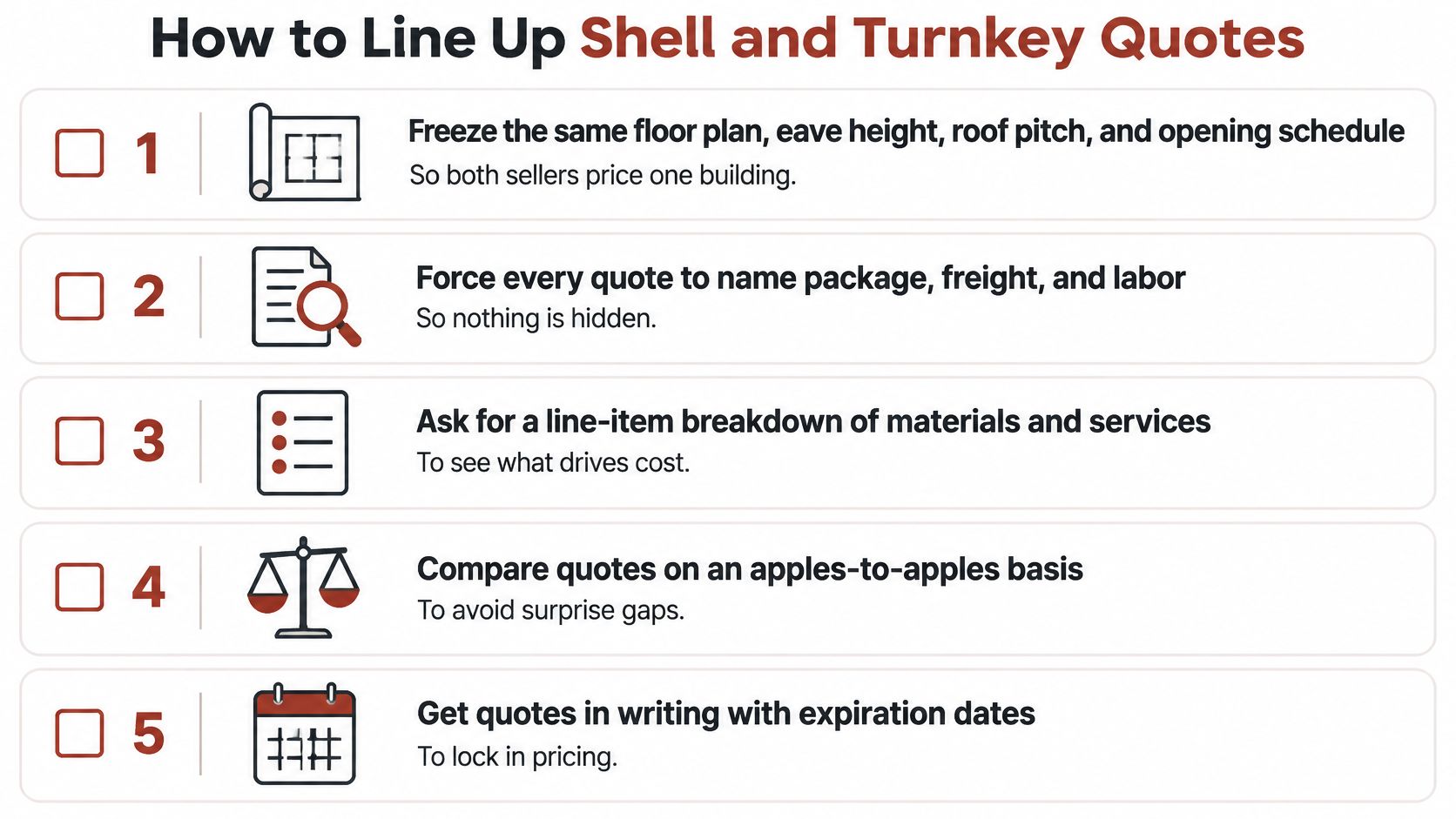
- Freeze the building. Lock one floor plan, eave height, roof pitch, and opening schedule so every seller prices the same structure. Without this, the comparison measures design changes, not builders.
- Force the nine line items. Require package, freight, engineering, foundation, erection, openings, weatherproofing, inspections, and utility penetrations on every quote.
- Label each line. Mark it included, allowance, or excluded. Then price every excluded line yourself before you add up a total.
- Rebuild the shell total. Add those excluded numbers to the shell bid, and set the turnkey bid beside the rebuilt figure rather than beside the kit price alone.
- Check the dates and the risk clauses. Quote date, expiration, and who pays for steel, freight, fuel, or redesign increases belong in the comparison.
- Confirm who pulls permits, who calls inspections, and who coordinates the finish crew. These are jobs with names attached, and unnamed jobs become yours.
- Prefer the bid whose missing lines you can hire. A gap you can fill with three phone calls is smaller than a gap requiring a general contractor.
Steps 2 and 6 get easier when the vocabulary matches what builders already publish. We keep buyer guides titled Financing guide, Questions to ask a builder, Turnkey builder scope, and Shell builder scope for exactly that reason, and our questions to ask a barndominium builder page turns them into an interview.
The decision rule is simple. Choose a shell when you'll manage finish-out yourself and the rebuilt total still beats turnkey. Choose turnkey when the unpaid lines are most of the project and you want one contract, one schedule, and one throat to choke.
Shortlist Builders Who Price the Same Scope
A shell price only compares when the builder builds this kind of structure and you can see whether they stop at shell or continue through finish-out. BarndoBuilderList is an independent U.S. directory, not a broker and not a paid placement list. It lists 1,512 researched builders after reading their own websites, and 752 of those builders have a dedicated barndominium page.
That dedicated page is website signal worth a first call, not an endorsement and not a promise about price. Shortlists put builders with a dedicated barndominium page first, builders with repeated website signal next, and builders with a single clear mention after that.
Location does quiet work on a shell budget. State pages and ZIP search, with radius choices of 50, 100, 150, and 250 miles, show which builders sit close enough that crew travel won't inflate erection. Start with your state or ZIP shortlist, open the barndominium shell builders near me guide, and contact only the builders who can price the stopping point you chose, whether that's kit, erected dried-in shell, or turnkey.
Then reuse the questions you've already built: inclusions, exclusions, expiration, escalation. Buyers can also describe their build and have listed builders checked on their behalf. The goal was never the lowest advertisement. It's a written scope, a validity date, and a builder whose published work matches the scope you're paying for.
BarndoBuilderList exists for the moment after you've read the price bands and still need names that fit your scope. Describe your build and we'll check with the listed builder and other builders in your state on your behalf, at no cost, then point you to a state or ZIP shortlist ranked by barndominium signal on each company's own site. Start at BarndoBuilderList and take the same nine line items into your first conversation.
- barndominium shell prices
- shell cost
- turnkey barndominium
- post-frame shell
- owner builder